

There is a temptation, on the centenary of Queen Elizabeth II’s birth, to rehearse the familiar arc: the young princess, the unexpected accession, the dutiful sovereign. Yet such narratives, however accurate, risk missing the more elusive quality of her reign—its peculiar relationship with power itself.
For what marked Elizabeth II’s seventy years on the throne was not the exercise of power in any direct sense, but the preservation of its appearance. She came to the Crown in 1952, at a moment when Britain could still plausibly regard itself as a global power. The Second World War had been won; the imperial structure, though already under strain, had not yet fully receded. By the time of her death, the geopolitical landscape had altered beyond recognition. And yet, curiously, the British state did not always seem to have diminished in proportion.
The explanation lies, at least in part, in the sovereign herself.
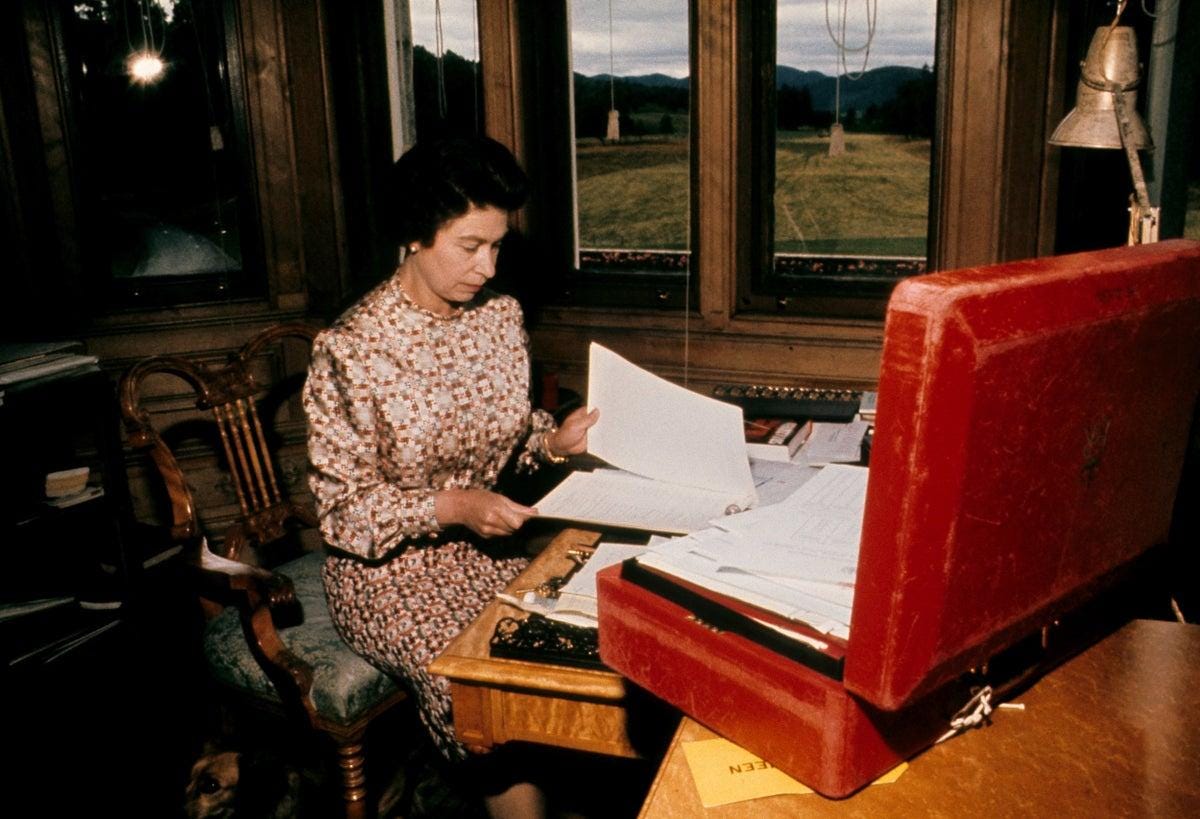
The British monarchy is often described as ceremonial, and in strict constitutional terms this is true. The Queen did not govern. She did not set policy. But to reduce her role to ornament is to misunderstand the subtler forms of influence embedded within the constitution. Her weekly audiences with successive prime ministers—from Winston Churchill to Rishi Sunak—were conducted in private, without record, and without fanfare. Yet they formed a continuous thread through modern British political life.
What she possessed, uniquely, was memory. Not the abstract memory of institutions, but the lived recollection of decisions taken, crises navigated, and assumptions once held with confidence. In those audiences, she represented a form of continuity that no elected official could match. Prime ministers came and went; she remained. That constancy did not confer authority in the executive sense, but it did shape the atmosphere in which authority was exercised. Britain continued, in part, to behave like a nation accustomed to global leadership because, in her presence, it still felt like one.
Nowhere was this more evident than in her stewardship of the Commonwealth of Nations. The Commonwealth is not an empire, nor even a coherent political bloc. It is a voluntary association, diverse to the point of contradiction. And yet, under the Queen, it acquired a degree of cohesion that exceeded its formal structure. This was not the product of constitutional design, but of personal commitment. She attended, she listened, she remembered. Leaders who had little else in common found, in her, a fixed point of reference.
It would be too strong to suggest that she prolonged Britain’s global power in any material sense. Economic and military realities admit of no such intervention. But it is not unreasonable to argue that she softened the experience of its decline. The Commonwealth, in her hands, became a kind of afterlife of influence—a space in which Britain could continue to convene, to host, and to matter, even as the terms of that importance evolved.
Ritual reinforced this impression. The great set-pieces of monarchy—the State Opening of Parliament, Trooping the Colour, the carefully choreographed state visit—were not empty theatre. They projected continuity, stability, and a certain quiet authority. Foreign dignitaries encountered not merely a country, but an institution that seemed to stand slightly apart from time. In diplomacy, such impressions are not trivial. They shape expectations; they confer a subtle advantage.
For much of her reign, this worked in Britain’s favour. The gap between perception and reality was not so wide as to invite scrutiny. But as the decades passed, the dissonance grew more pronounced. Britain’s relative position in the world shifted, sometimes gradually, sometimes abruptly. Yet the presence of the Queen—familiar, unchanging, quietly assured—made that shift less immediately apparent.
Only in retrospect does the full effect become clear. Her reign provided a form of reassurance: that whatever transformations were underway, something essential endured. It is possible that this reassurance came at a cost. A nation that feels itself continuous may be slower to reconsider its place in the world. A state that appears stable may postpone difficult adjustments.
None of this diminishes her achievement. On the contrary, it clarifies it. Her “quiet power” did not lie in altering the course of events, but in shaping how those events were experienced—by her governments, by her counterparts abroad, and by her people. She did not hold Britain at the height of global power. But for much of her long life, she ensured that it remained, in spirit and in presentation, a country that had not entirely relinquished the habit of it.
That, in the end, may be the most subtle legacy of all.