

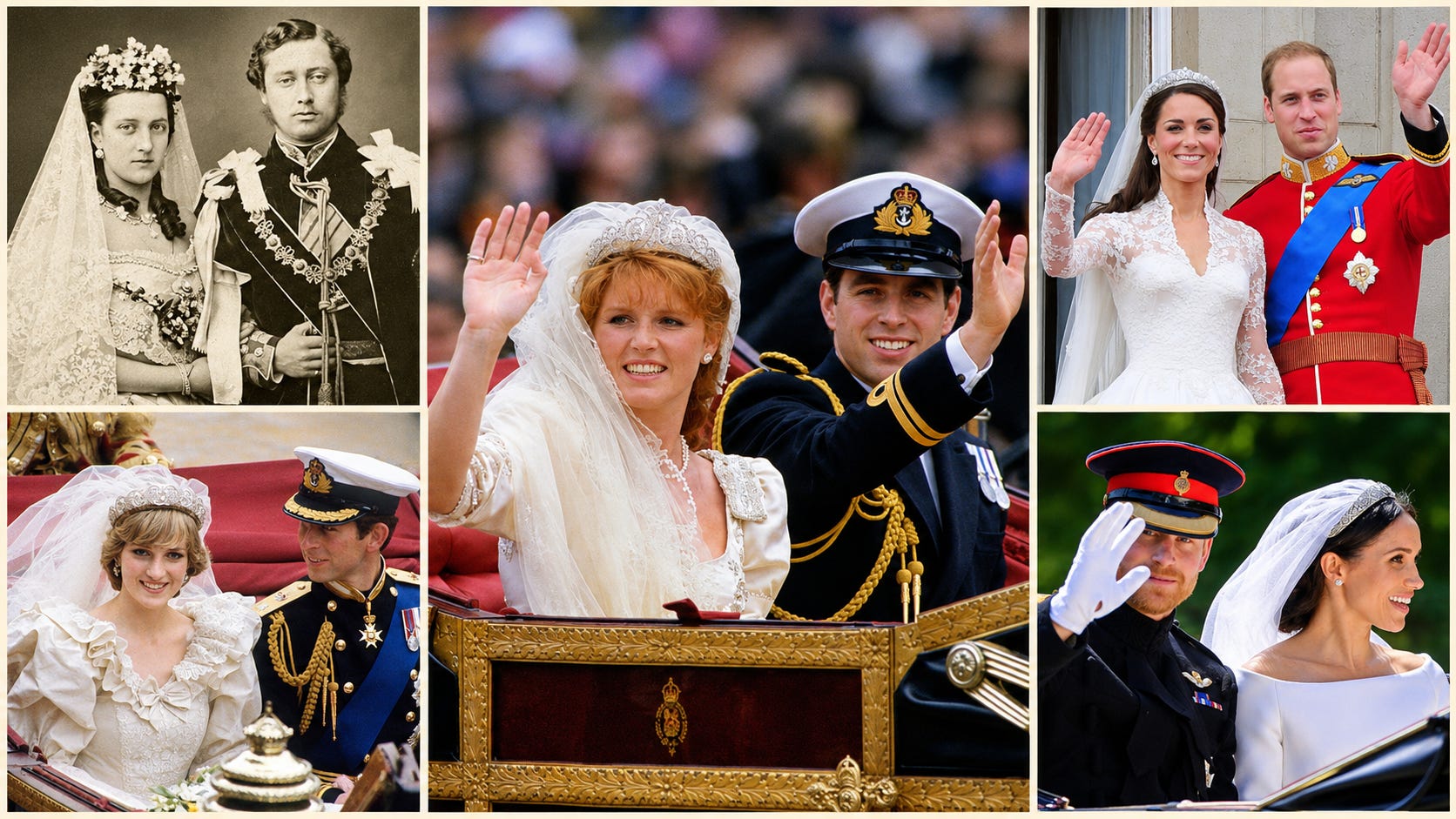
When a British prince gets married, there’s a familiar ritual. The newspapers speculate about which dukedom he might receive, royal watchers debate the merits of various historic titles, and Buckingham Palace eventually makes an announcement.
It all seems very traditional. After all, Prince William became Duke of Cambridge around the time of his marriage to Catherine Middleton in 2011, and Prince Harry became Duke of Sussex when he married Meghan Markle in 2018. Their uncle Andrew had become Duke of York on his wedding day in 1986.
So, clearly, British princes have been receiving dukedoms as wedding presents for centuries.
Haven’t they?
Well, not quite.
What counts as a wedding present?
Before we start counting, we need some rules.
First, we’re looking for sons of the reigning monarch. Not grandsons, nephews or distant cousins. We’ll come back to those later.
Second, the prince must actually receive a dukedom. An earldom or some other peerage won’t do.
And third, we’re going to be unusually strict about the timing. The dukedom must be granted on the wedding day itself. Not the previous week, not a month earlier, and not several years before the wedding.
We’ll also need to distinguish between the date a title is announced and the date the formal Letters Patent grant it. As we’ll discover, those aren’t necessarily the same.
These rules might seem unnecessarily pedantic. But they produce some rather surprising results.
The modern tradition
Let’s start with the sons of Queen Elizabeth II.
Her eldest son, Charles, married Lady Diana Spencer on 29 July 1981. By then, he had been Prince of Wales for more than twenty years and Duke of Cornwall since his mother’s accession in 1952. He already possessed one of the most prestigious dukedoms in the country, and there was no need to create another for him.
His younger brother Andrew married Sarah Ferguson at Westminster Abbey on 23 July 1986. That morning, the Queen created him Duke of York, Earl of Inverness and Baron Killyleagh.
That’s a clear example. A reigning monarch’s son, receiving a dukedom on his wedding day. The Letters Patent were explicitly dated 23 July 1986.
Now consider their youngest brother.
When Prince Edward married Sophie Rhys-Jones on 19 June 1999, he was created Earl of Wessex and Viscount Severn. No dukedom was involved.
Edward eventually became Duke of Edinburgh in March 2023, when his elder brother Charles III granted him the title on his 59th birthday. Almost 24 years after his wedding.
So, of Elizabeth II’s three sons who married during her reign, only one received a dukedom on his wedding day.
What about the next generation?
Prince William married Catherine Middleton on 29 April 2011. The Queen granted him the titles Duke of Cambridge, Earl of Strathearn and Baron Carrickfergus.
But there’s an interesting complication. Buckingham Palace announced the titles on 28 April, the day before the wedding, saying that the Queen had conferred the dukedom that day. However, the formal Letters Patent were dated 26 May, almost a month after the ceremony.
So although William’s dukedom was unquestionably associated with his marriage, neither the announcement nor the formal creation falls on the wedding day itself.
Under our strict rules, William doesn’t qualify.
Prince Harry, however, does qualify under the usual convention of treating the royal announcement as the grant. On the morning of his wedding to Meghan Markle on 19 May 2018, Buckingham Palace announced that the Queen had conferred on him the titles Duke of Sussex, Earl of Dumbarton and Baron Kilkeel.
There’s another technicality here, of course. William and Harry were grandsons of the reigning monarch, not sons. Their father Charles wouldn’t become king until 2022.
So neither belongs on our original list anyway.
And that leaves us with Prince Andrew.
Surely there must be dozens of earlier examples?
Back to the Victorians
Queen Victoria had four sons who survived to adulthood, and all four married.
Her eldest son, Albert Edward, was born on 9 November 1841 and automatically became Duke of Cornwall as the eldest son of the reigning monarch. He was created Prince of Wales on 8 December, just under a month later. When he married Alexandra of Denmark in 1863, he received no new dukedom.
Her second son, Alfred, was created Duke of Edinburgh in 1866. He married Grand Duchess Maria Alexandrovna of Russia in 1874, almost eight years later.
Her third son, Arthur, was created Duke of Connaught and Strathearn in 1874. He married Princess Louise Margaret of Prussia in 1879.
And her youngest son, Leopold, was created Duke of Albany in 1881, the year before his marriage to Princess Helena of Waldeck and Pyrmont.
Four sons, four marriages, and not a single wedding-day dukedom.
But there is a pattern here. Alfred, Arthur and Leopold all received their dukedoms on 24 May—Queen Victoria’s birthday.
Apparently, Victoria thought the appropriate occasion for giving her sons a dukedom wasn’t their wedding day. It was her birthday.
The twentieth-century princes
Perhaps things changed with Victoria’s descendants.
George V had three younger sons who received dukedoms and subsequently married.
Prince Albert, the future George VI, became Duke of York in 1920. He married Lady Elizabeth Bowes-Lyon in 1923.
Prince Henry became Duke of Gloucester in 1928. He married Lady Alice Montagu Douglas Scott in 1935.
Prince George became Duke of Kent in October 1934. He married Princess Marina of Greece and Denmark the following month.
That last example is particularly interesting. The dukedom was clearly associated with an impending royal marriage, but it was still granted weeks before the ceremony.
Once again, no wedding-day dukedoms.
We should also mention Prince Philip, who was created Duke of Edinburgh on 19 November 1947, the day before his marriage to the future Elizabeth II.
Philip wasn’t the son of a British monarch, so he wouldn’t qualify for our list anyway. But his case illustrates how closely a dukedom can be associated with a wedding without actually being granted on the wedding day.
The Hanoverians weren’t much help either
Working backwards through the eighteenth century produces much the same result.
George III had a large family, including several sons who became dukes. But their titles generally predated their marriages.
His second son, Frederick, was created Duke of York and Albany in 1784. He married Princess Frederica Charlotte of Prussia in 1791.
His third son, William, the future William IV, became Duke of Clarence and St Andrews in 1789. He didn’t marry Princess Adelaide of Saxe-Meiningen until 1818.
Prince Edward, Duke of Kent and Strathearn, received his dukedom in 1799 and married Princess Victoria of Saxe-Coburg-Saalfeld in 1818. Their only child would become Queen Victoria.
And so it goes on.
The earlier Hanoverian kings provide plenty of examples of royal dukedoms, but no convincing additions to our list of wedding-day creations.
Indeed, many princes received their titles while still young and unmarried. A dukedom was often a matter of royal status and provision rather than a reward for finding a bride.
A surprise from the seventeenth century
To find something more interesting, we need to go back to the reign of Charles II.
Charles had no legitimate children, but he certainly wasn’t short of sons.
One of them was James Scott, better known as the Duke of Monmouth. Born in 1649, James was the king’s illegitimate son by Lucy Walter.
In 1663, at the age of just fourteen, James married Anne Scott, the wealthy young Countess of Buccleuch.
James was already Duke of Monmouth, but on the day of their marriage, the couple were created Duke and Duchess of Buccleuch.
So here, at last, is another example of a royal son receiving a dukedom on his wedding day.
Admittedly, it comes with a few qualifications.
James was illegitimate. He was already a duke. And the new Scottish dukedom was closely connected with his wife’s inheritance and the arrangements for preserving the Buccleuch estates and family name.
But it was still a dukedom granted to a king’s son on his wedding day.
And it’s worth remembering what happened next.
In 1685, following the death of Charles II, Monmouth attempted to overthrow his uncle, James II and VII. His rebellion failed, and he was executed for treason.
His titles were forfeited, but Anne’s independent rights to the Buccleuch dukedom survived. The title continues to exist today.
Perhaps not the happiest precedent for a royal wedding tradition.
So where did the tradition come from?
What our historical tour suggests is that two different customs have become confused.
The first is the longstanding practice of granting dukedoms to royal princes. That really does have centuries of history behind it.
The second is the much more specific idea that a prince should receive his dukedom on his wedding day.
That seems to be a considerably more recent expectation.
Historically, royal dukedoms served several purposes. They established a prince’s rank, provided him with an identity within the peerage, and sometimes accompanied financial arrangements intended to support him.
Marriage could be a convenient occasion for granting a title, but it wasn’t necessarily the determining factor.
Sometimes a prince became a duke years before marrying. Sometimes he received his title shortly before the wedding. Sometimes he already held one from birth. And sometimes, as with Prince Edward, he received something other than a dukedom.
The modern expectation may owe much to the publicity surrounding royal weddings. A new dukedom provides a convenient new title for the bride, and a ready-made identity for the newly married couple.
It’s a neat arrangement. But neat arrangements aren’t necessarily ancient traditions.
A tradition of one?
Let’s return to our original question.
How many legitimate sons of reigning British monarchs have received dukedoms on their actual wedding days?
After working backwards through more than three centuries of royal marriages, we’ve found just one clear example: Prince Andrew in 1986.
Expand the definition to include grandsons, and Prince Harry joins the list, at least on the basis of the wedding-day announcement.
Include illegitimate sons, and we can add James Scott, Duke of Monmouth, in 1663.
There may be obscure historical cases that have escaped this survey, but the evidence certainly doesn’t support the idea of an unbroken, centuries-old custom.
And that leaves us with a rather amusing conclusion.
The next time a royal prince announces his engagement and the newspapers confidently explain that he’ll receive a dukedom because it’s traditional, it might be worth asking exactly which tradition they mean.
Because if we’re being strict about it, the great British tradition of giving princes dukedoms on their wedding days looks suspiciously like something we’ve invented in living memory.
Photograph credits (left to right): John Jabez Edwin Mayall (1863, public domain); United Press International (1981, public domain in the US); Elke Wetzig (1986, CC BY-SA 3.0); Magnus D (2011, CC BY 2.0); Londisland (2018, CC BY 3.0).
Original photographs: Wikimedia Commons. Images cropped, resized and arranged into a collage. Collage shared under CC BY-SA 3.0.


