

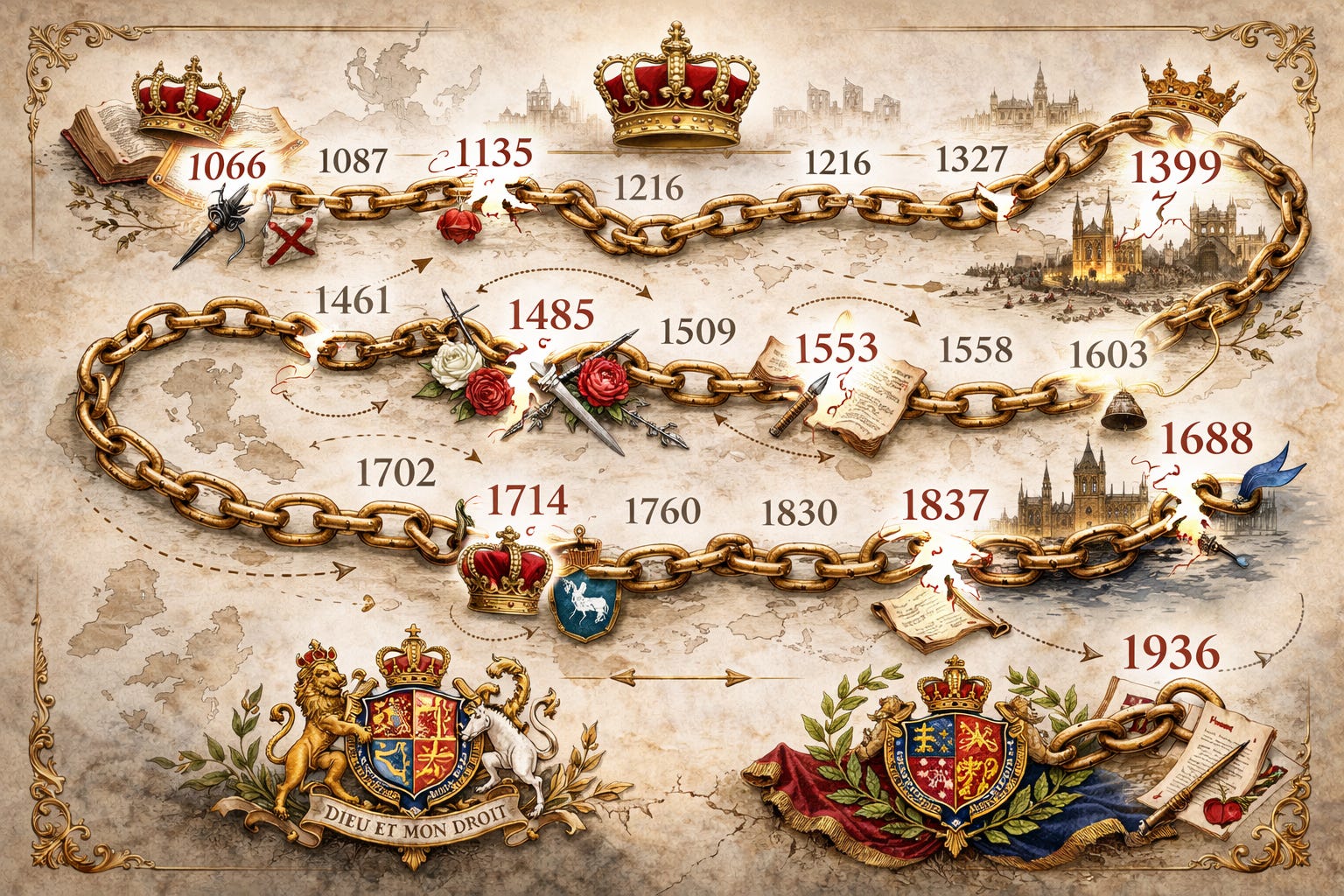
For most of the past millennium, the English — later British — Crown has followed a recognisable hereditary principle: the monarch is succeeded by their eldest legitimate son, or - in the absence of sons - by their eldest legitimate daughter.
Until the twenty-first century, this operated under male-preference primogeniture. Only with the Succession to the Crown Act 2013 was absolute primogeniture introduced for those born after 28 October 2011.
Yet the history of the monarchy since 1066 shows that while the principle has been consistent, its application has sometimes been turbulent - and occasionally set aside altogether.
It is helpful to distinguish between three very different kinds of exception.
I. When the Rulebook Was Thrown Out
These were moments of deposition, conquest, parliamentary revolution, or dynastic collapse - when the established order of succession was overridden by force or statute.
1. William I (1087)
When Edward the Confessor died in January 1066 without children, the succession was disputed. William, Duke of Normandy, claimed that Edward - his distant cousin - had previously promised him the English throne, and that Harold Godwinson had sworn an oath to uphold that claim. Harold, however, was chosen king by the Witan and crowned as Harold II of England. William regarded this as both a personal betrayal and a violation of a solemn oath. His invasion was therefore presented not as conquest alone, but as the enforcement of what he believed to be his lawful right.
On his death, William left Normandy to his eldest son Robert Curthose, but England to his second son William II. The inheritance of the English Crown was treated as a political choice rather than an automatic right.
2. Henry I and The Anarchy (1135)
Henry I of England had secured recognition of his daughter, the Empress Matilda, as heir. Yet upon his death, Stephen seized the throne. The result was civil war - proof that hereditary right alone did not guarantee accession.
When Stephen died, he passed the succession to Matilda’s son, Henry II.
3. Richard II (1399)
Richard II of England, childless, was deposed by Henry Bolingbroke, who reigned as Henry IV. Parliament retrospectively justified what was, in essence, a usurpation.
4. The Wars of the Roses (1455-1487)
The fifteenth century saw succession repeatedly overturned:
Henry VI of England was deposed by Edward IV, despite having a son.
Edward V of England was displaced by his uncle, Richard III.
Richard III of England fell in battle, ending the Yorkist line and putting Henry VII, the first Tudor king, on the throne.
Here, heredity yielded entirely to force of arms.
5. Edward VI (1553)
Edward was 15 when he died and had no children. He named his cousin, Lady Jane Grey, as his heir, but she was unable to retain it, and after only nine days, the throne was seized by his half-sister, Mary I
6. The Glorious Revolution (1688)
James II of England had a legitimate son. Yet Parliament declared that he had abdicated and offered the Crown jointly to William III and Mary II (James’s daughter and her husband. This was not a technical quirk - it was a constitutional revolution.
7. The Abdication Crisis (1936)
Edward VIII abdicated. With no children, the Crown passed to his brother George VI - a lawful transfer, but one precipitated by unprecedented personal and constitutional circumstances.
II. When the Rules Produced a Different Outcome
In these cases, the established succession rules were followed - yet they resulted in someone other than the monarch’s eldest child inheriting.
1. Henry VII (1509)
Henry’s eldest son, Prince Arthur, died at the age of 15 with no children. On Henry’s death, the Crown went to his second son, Henry VIII.
2. Mary I (1558)
Mary died childless and was succeeded by her half-sister, Elizabeth I.
3. Elizabeth I (1603)
Elizabeth was unmarried and had no children. When she died, the Crown passed to her nearest relative, James VI of Scotland, who became James I of England. He was Elizabeth’s first cousin twice removed.
4. Charles II (1685)
Charles II had no legitimate children and was succeeded by his brother James VII of Scotland and II of England.
4. William III (1702)
William III reigned jointly with his wife, Mary II, until her death in 1694. After that he reigned alone until his death in 1702. The couple had no children, so he was succeeded by Mary’s sister, Anne. Mary and Anne’s brothers had all been removed from the succession because they were Catholic.
5. Anne (1714)
Anne died in 1714 with no surviving issue. Under the Act of Settlement 1701, the Crown passed to her nearest Protestant relative, George, Elector of Hanover - her second cousin - inaugurating the House of Hanover.
6. George II (1760)
George II’s eldest son was Frederick, Prince of Wales. Frederick predeceased his father, so his father was succeeded by Frederick’s son, George III.
7. George IV (1830)
George IV’s only child, Princess Charlotte, predeceased him, so he was succeeded by his younger brother, William IV.
8. William IV (1837)
William died with no living, legitimate descendants, so he was succeeded by the daughter of his younger brother Prince Edward (who had died in 1820). She became Queen Victoria.
9. Edward VII (1910)
Edward’s eldest son, Prince Albert Victor, predeceased his father, so he was succeeded by his second son, George V.
III. The Corner Cases
Finally, there are a few monarchs whose successions occurred amid instability but ultimately conformed to hereditary principle:
John (1216) - His son Henry III succeeded despite French invasion.
Edward II (1327) - Deposed, but succeeded by his son Edward III.
Charles I (1649) - Executed, yet his son Charles II was king de jure throughout the Interregnum.
These episodes appear anomalous but did not, strictly speaking, violate the rule.
A Thousand Years of Elastic Continuity
Across nearly a millennium, the principle of hereditary succession has shown remarkable resilience. Yet it has also been shaped by conquest, statute, civil war, religion, and personal decision.
The “rule” has endured, but history reminds us that it has never been entirely immune from circumstance.