

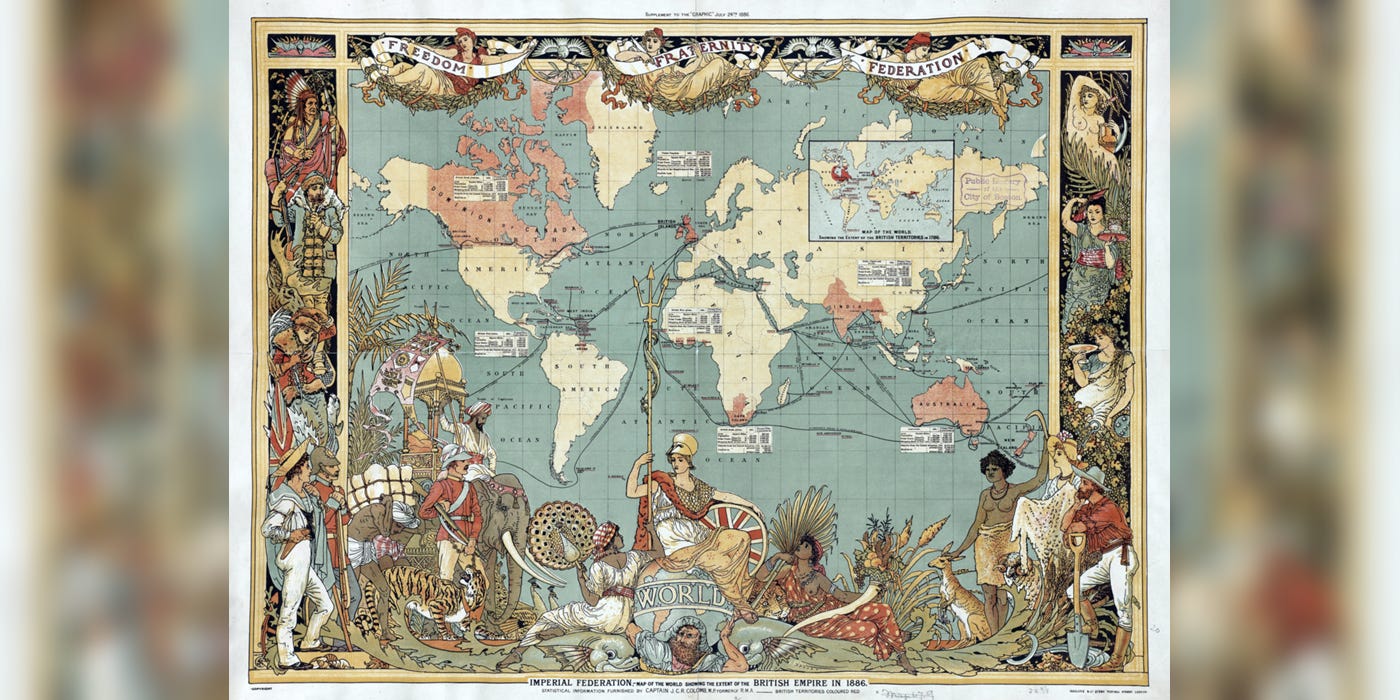
At its height, the British Empire governed nearly a quarter of the world’s population and territory. From Canada to India, from Australia to the Caribbean, the Crown stood at the centre of an enormous imperial system that shaped global politics for centuries.
Yet the Empire that once claimed territories across every inhabited continent no longer exists.
What survived instead was something very different: the modern Commonwealth — a voluntary association of independent nations, some of which still recognise the monarch as head of state, and many of which do not.
For the British monarchy, this transformation was one of the greatest constitutional reinventions in modern history. The Crown evolved from the symbol of imperial rule into a largely diplomatic and ceremonial institution shared among sovereign nations.
The British Empire ended. The monarchy adapted.
The British Empire at its Height
By the early twentieth century, the British Empire had become the largest empire in history. Britain governed colonies, protectorates, dominions, and territories across Africa, Asia, the Americas, the Caribbean, and the Pacific.
The monarch was not merely a symbolic figurehead. The Crown represented imperial authority itself.
Queen Victoria’s assumption of the title Empress of India in 1876 reflected the monarchy’s central place within imperial identity. Royal ceremonies, tours, portraits, and symbols reinforced the idea that the sovereign sat at the apex of a global imperial system.
But beneath the surface, constitutional change had already begun.
The Rise of the Dominions
Some territories within the Empire gradually gained substantial self-government. These became known as the Dominions.
Countries including:
Canada
Australia
New Zealand
South Africa
the Irish Free State
increasingly governed their own domestic affairs while still recognising the same monarch.
This created an important constitutional question:
Was the King ruling one empire — or several independent nations sharing one Crown?
The answer emerged gradually during the 1920s and 1930s.
The Balfour Declaration and the Statute of Westminster
The 1926 Imperial Conference produced the Balfour Declaration, which recognised Britain and the Dominions as:
“equal in status, in no way subordinate one to another.”
This principle was then formalised by the Statute of Westminster in 1931, one of the most important constitutional laws in modern Commonwealth history.
The statute recognised that:
Britain could no longer legislate freely for the Dominions
each Dominion possessed constitutional equality
the Crown existed separately within each realm
This was the moment the monarchy effectively ceased to be purely “British”.
Instead, the sovereign became separately:
King of the United Kingdom
King of Canada
King of Australia
and so forth
Constitutional scholars sometimes describe this as the “divisible Crown”.
It remains one of the defining features of the modern monarchy.
The “Divisible Crown” Explained
Today, King Charles III is not simply a British monarch whose authority extends overseas.
Legally speaking, he is separately sovereign of each Commonwealth realm.
That distinction matters enormously.
For example:
the Canadian government advises the King on Canadian matters
the Australian government advises him on Australian affairs
Governors-General represent the Crown independently in each realm
This is why constitutional changes involving the monarchy often require consultation among multiple realms rather than decisions by Westminster alone.
The monarchy may appear unified ceremonially, but constitutionally it is shared among distinct sovereign states.
Decolonisation After the Second World War
The Second World War accelerated the collapse of European empires across the world, including Britain’s.
The most significant turning point came in 1947, when India achieved independence.
India had long been regarded as the “jewel in the crown” of the Empire. Its independence fundamentally altered Britain’s global position and marked the beginning of rapid decolonisation throughout Asia, Africa, and the Caribbean.
Over the following decades:
colonies became independent nations
some retained the monarchy
others became republics
Britain increasingly abandoned the language of “Empire” in favour of “Commonwealth”
For the monarchy, this required another transformation.
The sovereign could no longer function as an imperial ruler. Instead, the Crown became a symbol of continuity, diplomacy, and voluntary association.
India and the Reinvention of the Commonwealth
India also forced the Commonwealth itself to evolve.
When India became a republic in 1950, a major constitutional problem emerged. Traditionally, Commonwealth membership had implied allegiance to the Crown.
If India removed the monarch as head of state, could it remain within the Commonwealth?
The solution changed the organisation permanently.
Commonwealth leaders agreed that republics could remain members while recognising the monarch only as the symbolic Head of the Commonwealth.
This was revolutionary.
The Commonwealth ceased to be an exclusively monarchical organisation and became instead a voluntary association of independent states.
That model continues today.
Elizabeth II and the Modern Commonwealth
No monarch shaped the modern Commonwealth more profoundly than Queen Elizabeth II.
Ascending the throne in 1952 during the height of decolonisation, Elizabeth II oversaw the transition from empire to Commonwealth across seven decades.
Throughout her reign:
dozens of territories gained independence
many countries became republics
the monarchy’s international role became increasingly diplomatic and symbolic
Rather than resisting these changes, Elizabeth II largely embraced them.
Her Commonwealth tours, speeches, and personal diplomacy consistently emphasised partnership and equality rather than imperial hierarchy.
For many historians, this adaptation explains why the Commonwealth survived at all.
Commonwealth Country vs Commonwealth Realm
These terms are frequently confused.
A Commonwealth country is any member of the Commonwealth of Nations.
Most Commonwealth members are republics.
A Commonwealth realm, however, is a Commonwealth country that recognises the British monarch as its own head of state.
Today, countries including:
Canada
Australia
New Zealand
Jamaica
remain Commonwealth realms.
Meanwhile:
India
South Africa
Barbados
are Commonwealth countries but not Commonwealth realms.
In short:
all Commonwealth realms are Commonwealth countries
not all Commonwealth countries are Commonwealth realms
The Role of Head of the Commonwealth
The title Head of the Commonwealth is separate from the monarchy itself.
It is:
symbolic rather than political
not automatically hereditary
distinct from being king or queen of any particular realm
The role involves:
representing the Commonwealth internationally
promoting cooperation among member states
serving as a symbolic figure of continuity
Although the position is not technically hereditary, Commonwealth leaders agreed in 2018 that King Charles III would succeed Elizabeth II in the role after her death.
Importantly, republics within the Commonwealth recognise the Head of the Commonwealth despite not recognising the monarch as their own head of state.
Barbados and the Modern Republican Model
A major modern example of constitutional change came in Barbados.
On 30 November 2021 — the 55th anniversary of Barbadian independence — the country formally became a republic.
Queen Elizabeth II ceased to be Queen of Barbados and was replaced as head of state by a Barbadian president.
Yet Barbados did not leave the Commonwealth.
Instead, it remained a Commonwealth member while ceasing to be a Commonwealth realm.
The transition occurred peacefully through constitutional reform rather than revolution, demonstrating how modern Commonwealth nations can alter their systems of government while maintaining broader international ties.
Then-Prince Charles attended the ceremony in Bridgetown, acknowledging both Barbados’s history and its sovereign constitutional choice.
The event illustrated how far the Commonwealth had evolved from its imperial origins.
Which Countries Could Become Republics Next?
Several Commonwealth realms continue to debate republicanism today, though the political circumstances vary considerably.
In Jamaica, governments have repeatedly expressed interest in replacing the monarchy with a republic, often linking the issue to national identity and the legacy of colonialism.
In Australia, republican sentiment remains an important constitutional debate more than two decades after the failed 1999 referendum. Questions about national identity, constitutional reform, and the role of the monarchy continue to surface periodically in Australian politics.
Elsewhere in the Caribbean, countries such as:
Belize
Bahamas
Antigua and Barbuda
have all seen varying degrees of republican discussion in recent years.
By contrast, constitutional change appears less likely in countries such as Canada and New Zealand, where legal complexities and political priorities make reform considerably more difficult.
What remains important, however, is that becoming a republic no longer means leaving the Commonwealth itself.
That distinction may prove increasingly significant in the decades ahead.
Conclusion
The end of the British Empire could easily have marked the end of the monarchy’s global role.
Instead, the Crown evolved.
Over the course of the twentieth century, the monarchy transformed from the centre of an imperial system into a shared constitutional institution existing across multiple independent nations.
The Commonwealth itself changed just as dramatically:
from empire to partnership
from hierarchy to voluntary association
from imperial governance to diplomatic cooperation
Today’s Commonwealth bears little resemblance to the British Empire from which it emerged.
Yet the monarchy remains woven into its history, its institutions, and — in some countries — its constitutional future.
The British Empire disappeared.
The Crown endured by changing with the world around it.