

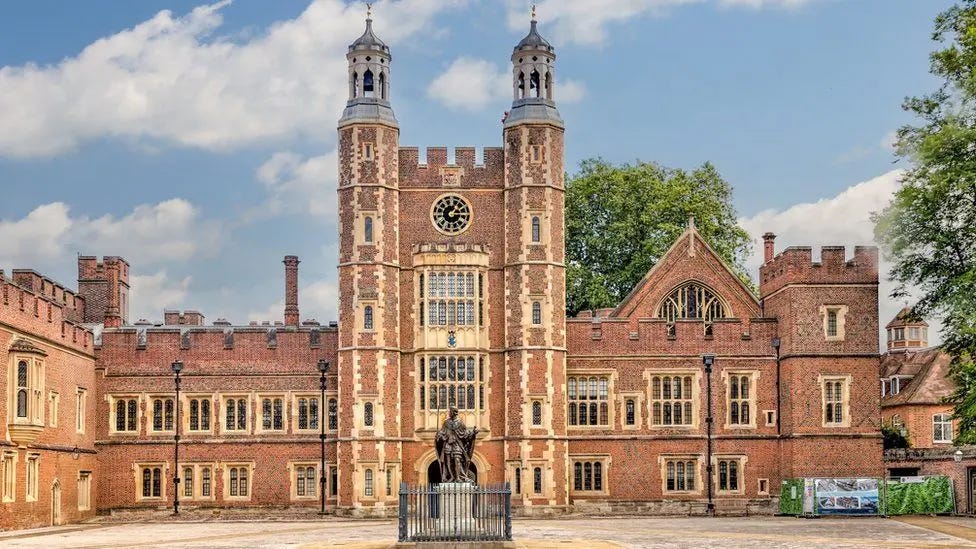
The announcement that Prince George will attend Eton College from September has brought to an end years of speculation about where the future king would continue his education.
At first glance, the decision appears to be a continuation of recent royal tradition. His father, Prince William, and his uncle, Prince Harry, both attended the famous Berkshire school. Yet viewed through the lens of history, George’s move to Eton is merely the latest chapter in a remarkable story about how royal education has evolved over the last two centuries.
From governesses in palace nurseries to elite boarding schools and university lecture halls, each generation of royals has been educated differently from the one before. The changing schools attended by Britain’s princes and princesses reveal much about changing attitudes towards childhood, duty and monarchy itself.
The Victorian Beginning: Education at Home
For much of the nineteenth century, royal children did not attend school in the way we understand it today.
Queen Victoria’s own childhood education took place almost entirely within Kensington Palace under the strict supervision of her mother, the Duchess of Kent, and Sir John Conroy. Languages, religion, history and music formed the core of her studies.
After becoming queen in 1837, Victoria and Prince Albert took a close interest in the education of their own nine children. Prince Albert, in particular, believed that intellectual development was essential for future sovereigns and princes.
Their children were educated largely by tutors and governesses within royal residences. They studied languages, mathematics, science, literature, art and history from an early age. The emphasis was on discipline and scholarship rather than formal schooling.
Yet even within Victoria’s family there were concerns that intense expectations could place considerable pressure upon young royals.
The Future Edward VII: A Prince Under Pressure
Victoria and Albert’s eldest son, Albert Edward—known within the family as Bertie and later King Edward VII—received an exceptionally rigorous education.
From childhood he was subjected to an intensive programme of private tuition designed by Prince Albert. Languages, constitutional history, religion and military subjects filled his timetable.
However, Bertie struggled to meet his parents’ expectations. His difficulties became a source of constant concern to both Victoria and Albert, who feared he lacked the intellectual seriousness required of a future monarch.
His experience highlighted a challenge that has accompanied royal education ever since: how to prepare a future sovereign for duty without overwhelming them with expectations.
The Children of George V: Duty, Service and Different Expectations
By the late nineteenth century, royal education was beginning to move beyond palace walls.
King George V firmly believed that princes should understand discipline, hierarchy and service. As a result, his sons experienced a far more structured upbringing than many modern royal children.
His eldest son, the future Edward VIII, was educated by tutors during childhood before entering the Royal Naval College at Osborne on the Isle of Wight at the age of twelve in 1906. He studied there until he was fourteen before progressing to the Royal Naval College, Dartmouth, where he remained until the age of sixteen.
His younger brother, the future George VI, followed a similar route. He attended Osborne between the ages of thirteen and fifteen before moving to Dartmouth until the age of seventeen. Although he was not expected to become king, his education stressed duty and military preparedness.
George V’s only daughter, Princess Mary, also received a carefully supervised royal education, though one shaped by the expectations placed upon aristocratic girls in the early twentieth century. Born in 1897, she was educated privately at home alongside aspects of her brothers’ early instruction, with lessons in languages, history, music, religion and the social accomplishments expected of a princess.
Her education was not directed towards naval college or military training, as it was for her brothers, but towards public service, charitable work and court life. During the First World War, while still in her late teens, Mary became closely associated with welfare and nursing causes, later training as a nurse and becoming a prominent supporter of the Girl Guides, the Voluntary Aid Detachment movement and numerous hospitals and charities.
The Duke of Gloucester, Prince Henry, attended St Peter’s Court preparatory school before Eton College from the age of thirteen to eighteen. He subsequently entered the Royal Military College, Sandhurst.
Prince George, Duke of Kent, attended St Peter’s Court and later Osborne and Dartmouth, while the youngest brother, Prince John, who suffered from epilepsy and died aged thirteen in 1919, was educated privately at Sandringham and Wood Farm.
By modern standards, George V’s parenting style could seem austere. Emotional reserve was considered a virtue, and military training formed a significant part of royal education. Yet the result was a generation whose lives were deeply shaped by service and public duty.
Princesses Elizabeth and Margaret: The Last Royals Educated Entirely at Home
The childhood education of Princess Elizabeth and Princess Margaret differed significantly from that of their uncles.
Born in 1926 and 1930 respectively, neither princess was initially expected to occupy the central role that history would eventually assign to them. Their education was therefore conducted privately under the supervision of their governess, Marion Crawford, affectionately known as “Crawfie”.
Elizabeth began formal lessons at around the age of six. Alongside Margaret, she studied literature, French, history, geography, music and religion.
Everything changed in 1936 when Edward VIII abdicated and Elizabeth’s father became George VI. At the age of ten, Elizabeth suddenly became heir presumptive.
Her education thereafter took on a more constitutional focus. From her early teens she received lessons in constitutional history and government from Henry Marten, Vice-Provost of Eton College. These studies were designed specifically to prepare her for her future role as sovereign.
The Second World War also influenced both sisters profoundly. During the conflict, they spent much of their time at Windsor Castle. Elizabeth undertook public duties as a teenager and joined the Auxiliary Territorial Service at the age of eighteen, training as a driver and mechanic.
Neither Elizabeth nor Margaret ever attended school. In many ways they represented the final generation of senior royals educated entirely within royal residences.
Queen Elizabeth II’s Children and a New Educational Philosophy
The birth of Prince Charles in 1948 marked the beginning of a new approach.
Queen Elizabeth II and Prince Philip believed that royal children should experience a broader education than previous generations. As a result, their children became pioneers in a gradual move towards mainstream schooling.
King Charles III
Charles began his education at Hill House School in west London at the age of eight in 1957, becoming the first heir apparent to attend a school rather than being educated solely by private tutors.
At the age of nine he moved to Cheam School in Berkshire, remaining there until he was thirteen.
In 1962, Charles entered Gordonstoun in Scotland at the age of thirteen. The school, attended previously by Prince Philip, was renowned for its demanding regime of outdoor activities, physical challenges and character-building exercises.
After spending two terms at Timbertop, Gordonstoun’s remote Australian campus, at the age of sixteen, Charles returned to Scotland and completed his education there before leaving at eighteen.
He then attended Trinity College, Cambridge, from the age of nineteen, reading archaeology and anthropology before switching to history. In 1970 he became the first heir to the throne to earn a university degree.
Princess Anne
Princess Anne attended Benenden School in Kent from the age of thirteen until eighteen.
Her years at Benenden coincided with the development of her passion for equestrian sport. Teachers and classmates frequently remarked upon her determination and independence, qualities that would become hallmarks of her public life.
Prince Andrew
Prince Andrew attended Heatherdown School from the age of seven until thirteen before following his brother to Gordonstoun between the ages of thirteen and eighteen.
He later joined the Royal Navy, reflecting the continued importance of military service within the royal family.
Prince Edward
Like Andrew, Prince Edward attended Heatherdown between the ages of seven and thirteen and Gordonstoun from thirteen to eighteen.
However, he subsequently followed an increasingly common path for younger royals by attending university. He studied history at Jesus College, Cambridge, graduating in 1986.
Diana’s Influence and a New Generation
The educational choices made for Princes William and Harry reflected changing attitudes towards royal childhood.
Diana, Princess of Wales, was determined that her sons should enjoy as normal an upbringing as possible while still recognising their unique position.
Prince William began at Mrs Mynors’ Nursery School in west London at the age of three. He later attended Wetherby School between the ages of four and eight before moving to Ludgrove School in Berkshire from eight to thirteen.
In 1995, at the age of thirteen, William entered Eton College. The decision was highly significant. He became the first future king to attend the school, breaking with the Gordonstoun tradition established by his father.
William remained at Eton until he was eighteen. Following a gap year spent in Chile, Belize and various parts of the United Kingdom, he enrolled at the University of St Andrews in Scotland in 2001 at the age of nineteen.
Initially studying art history before switching to geography, William graduated in 2005 with a degree in geography.
His years at St Andrews proved historically significant for another reason. It was there that he met Catherine Middleton, a fellow student who would eventually become his wife and the future Princess of Wales.
Prince Harry followed a remarkably similar educational path. He attended Wetherby School between the ages of four and eight, Ludgrove from eight to thirteen and Eton College from thirteen to eighteen.
Unlike his brother, Harry chose not to attend university, instead entering military training and subsequently serving in the British Army for ten years.
The Wales Children and the Twenty-First Century Monarchy
The Prince and Princess of Wales have sought to combine lessons from all the generations that came before them.
Prince George attended Westacre Montessori School Nursery in Norfolk from the age of two before joining Thomas’s Battersea at four. Following the family’s move to Windsor, he entered Lambrook School at the age of nine alongside Princess Charlotte and Prince Louis.
Now, at the age of thirteen, George is preparing to follow his father and uncle to Eton College.
His educational journey already reflects many of the changes that have transformed royal childhood over the past two centuries. Unlike Queen Elizabeth II, he has attended school from an early age. Unlike George V’s sons, he has not been prepared primarily for military service. Unlike Charles, he has grown up in an era shaped by digital technology and social media.
Yet there are also clear continuities. Like previous generations, George’s education is intended not simply to provide academic qualifications but to prepare him for a life of public service.
From the private tutors of Queen Victoria’s era to the classrooms of Eton, royal education has continually evolved in response to changing times. Prince George’s next step is not merely a school move; it is the latest chapter in a story that stretches back more than two hundred years.