

There are few countries whose creation can be traced across so many centuries of warfare, dynastic ambition, invasion, and political change as England.
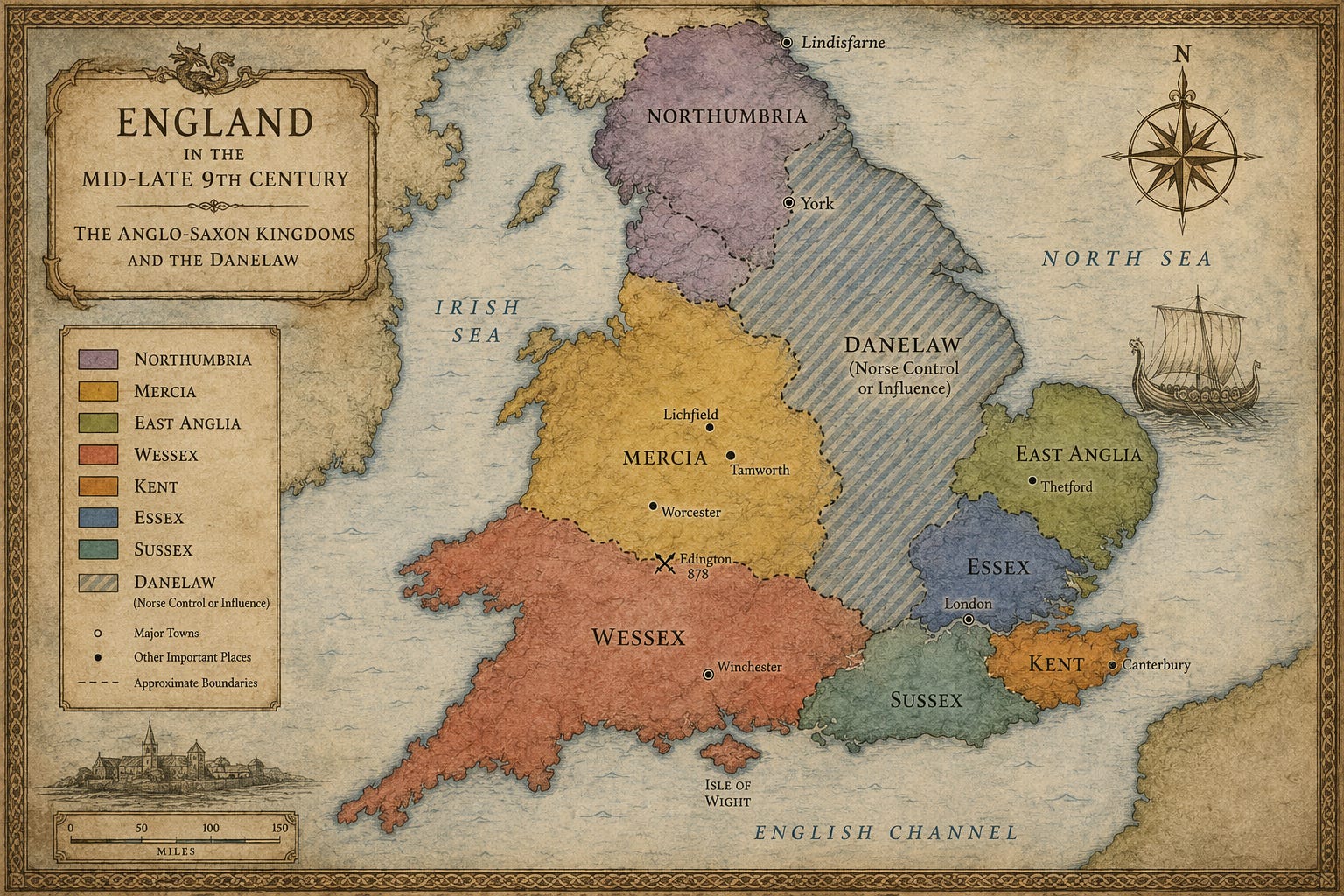
What we now think of as a single nation began instead as a fractured landscape of competing kingdoms and regional loyalties. In the centuries following the collapse of Roman Britain in AD 410, no ruler governed the whole country, and no unified “English” kingdom yet existed. Instead, power shifted constantly between rival realms including Mercia, Northumbria, Kent, East Anglia, and Wessex.
The England that eventually emerged was not inevitable. It was forged gradually — through conquest and diplomacy, Viking invasions and royal reform — before surviving one final transformational conquest in 1066.
And at the heart of that story stood the kings of Wessex.
AD 410 - The End of Roman Britain
For almost four centuries, Britain had formed part of the Roman Empire. Roman towns, roads, villas, and military fortifications stretched across much of the province, particularly in the south and east.
But in the early fifth century, as the Roman Empire came under mounting pressure elsewhere in Europe, imperial authority in Britain collapsed. Around AD 410, the Emperor Honorius reportedly instructed the cities of Britain to look to their own defences.
Roman administration faded. Troops withdrew. Urban life declined in many regions. Into this political vacuum emerged a patchwork of local rulers and competing powers.
Over the following generations, Germanic-speaking migrants from northern Europe — traditionally identified as Angles, Saxons, and Jutes — established settlements across much of southern and eastern Britain. From these territories gradually emerged a series of Anglo-Saxon kingdoms.
Later medieval writers would call them the “Heptarchy”: the seven kingdoms of Northumbria, Mercia, East Anglia, Essex, Kent, Sussex, and Wessex. In reality, the political map was far less tidy. Borders shifted frequently, kingdoms rose and fell, and smaller territories often disappeared altogether beneath stronger neighbours.
There was, as yet, no England.
Seventh and Eighth Centuries - Rival Kingdoms Compete for Power
By the seventh century, several major Anglo-Saxon kingdoms had established themselves as dominant regional powers.
Northumbria controlled much of northern England and became an important centre of learning and Christianity. Mercia emerged as the leading power in the Midlands. Wessex consolidated authority in the south-west.
For long periods, Mercia appeared the most likely candidate to dominate England. Under King Offa, who ruled from AD 757 to 796, Mercian influence reached extraordinary heights. Offa corresponded with Charlemagne, issued sophisticated coinage, and oversaw the construction of the great earthwork still known as Offa’s Dyke along the Welsh border.
Yet even Offa never ruled a united England. Anglo-Saxon kings exercised overlapping and often unstable authority. Power depended heavily upon military success and personal allegiance rather than fixed national institutions.
That instability would soon be tested by a new and devastating threat.
AD 793 - The Vikings Arrive
In AD 793, Viking raiders attacked the monastery at Lindisfarne off the coast of Northumbria.
Though not the first Scandinavian raid on Britain, the assault shocked Christian Europe and later became symbolic of the beginning of the Viking Age. Over the following decades, Scandinavian attacks intensified. What began as seasonal raiding gradually developed into organised conquest and settlement.
Then, in AD 865, a large Viking force known to later chroniclers as the Great Heathen Army landed in England.
Within a generation, much of Anglo-Saxon England had fallen.
East Anglia was conquered. Northumbria collapsed. Mercia was broken apart. Viking rulers established themselves across large areas of northern and eastern England — territory later known as the Danelaw.
Only one major Anglo-Saxon kingdom survived intact.
Wessex.
AD 871 - Alfred and the Survival of Wessex
In AD 871, Alfred became King of Wessex amid near-constant Viking attacks.
His later reputation as “Alfred the Great” can sometimes obscure how precarious his position initially was. By the winter of AD 878, Viking forces under Guthrum had driven Alfred into hiding in the Somerset marshes at Athelney.
Yet Alfred recovered dramatically.
In May AD 878, he defeated Guthrum at the Battle of Edington. The victory secured Wessex’s survival and led to a settlement dividing England between Anglo-Saxon and Viking-controlled territories.
Alfred’s true significance, however, lay not only in military victory but in political transformation.
Recognising that Viking attacks would continue, Alfred reorganised the defences of Wessex through a network of fortified towns known as burhs. He reformed military obligations, improved administration, promoted education, and encouraged the use of written English.
Increasingly, Alfred presented himself not merely as king of the West Saxons, but as protector of the English peoples not yet under Viking rule.
In AD 886, after Alfred recaptured London, a contemporary chronicle declared that “all the English people” outside Danish control submitted to him.
The idea of a wider English identity had begun to emerge.
AD 899–924 - Edward the Elder and Æthelflæd
When Alfred died in AD 899, the task of expanding Wessex’s authority fell to his son Edward the Elder and, crucially, to Edward’s sister Æthelflæd.
Following the death of her husband in AD 911, Æthelflæd became ruler of Mercia in her own right — an extraordinary position for a woman in early medieval Europe. Known as the “Lady of the Mercians”, she proved both politically capable and militarily formidable.
Working in close cooperation, Edward and Æthelflæd systematically reconquered Viking-held territories. New fortified towns were established across the Midlands and eastern England. Danish strongholds fell one by one.
By the time of Æthelflæd’s death in AD 918, the balance of power had shifted decisively.
Wessex was no longer simply one kingdom among many.
It was becoming the dominant power in England.
AD 927 - Æthelstan and the Birth of England
The decisive breakthrough came under Alfred’s grandson, Æthelstan.
Raised partly in Mercia and inheriting both West Saxon and Mercian traditions, Æthelstan became king in AD 924. Three years later, in AD 927, he captured York — the last major Viking kingdom in England.
For the first time, a single ruler controlled territory stretching from the south coast to Northumbria.
Contemporary charters increasingly described Æthelstan not merely as King of Wessex, but as Rex Anglorum — “King of the English”.
Many historians therefore regard AD 927 as the true beginning of the Kingdom of England.
Yet Æthelstan’s new kingdom remained vulnerable. In AD 937, a powerful alliance of Scottish, Viking, and Strathclyde forces invaded England in an attempt to destroy his authority.
The result was the Battle of Brunanburh.
Though historians still debate precisely where the battle took place, its importance is beyond doubt. Contemporary writers regarded it as one of the greatest battles ever fought in Britain. Æthelstan’s victory preserved the unity of England and established Wessex’s supremacy beyond serious challenge.
An Old English poem celebrating the triumph declared that England had been made whole.
Tenth Century - England Consolidated
The rulers who followed Æthelstan strengthened the institutions of the emerging kingdom.
Under kings such as Edmund, Eadred, and particularly Edgar, England became increasingly centralised and administratively sophisticated. Royal authority expanded through systems of taxation, law, coinage, and local government based around shires and royal officials.
By the later tenth century, England possessed something unusual in early medieval Europe: a relatively coherent and unified kingdom governed through increasingly effective royal administration.
But England’s stability remained fragile.
The Vikings would return.
AD 1016 - Cnut Conquers England
Renewed Scandinavian invasions at the end of the tenth century plunged England once again into crisis.
In AD 1016, the Danish prince Cnut defeated Edmund Ironside and became King of England.
Yet significantly, Cnut did not dismantle the English kingdom. Instead, he ruled through its existing structures, laws, taxation systems, and royal institutions. England had become too politically coherent to be treated merely as a collection of conquered territories.
Indeed, Cnut’s reign demonstrated how far England had evolved since Alfred’s day. A Scandinavian conqueror could now inherit the machinery of an established kingdom.
AD 1042 - Edward the Confessor
After the end of Danish rule, the House of Wessex returned to power in AD 1042 with Edward the Confessor.
Edward’s reign brought relative stability, but it also exposed growing tensions within the English political elite. Powerful aristocratic families — particularly the Godwins — competed fiercely for influence at court.
Meanwhile, Edward’s lack of an heir created uncertainty over the succession.
That uncertainty would explode dramatically in AD 1066.
AD 1066 - The Norman Conquest
Edward the Confessor died on 5 January AD 1066.
The following day, Harold Godwinson was crowned king. But his claim was immediately contested by two formidable rivals: Harald Hardrada of Norway and William, Duke of Normandy.
What followed was one of the most consequential succession crises in English history.
In September AD 1066, Harald Hardrada invaded northern England alongside Harold Godwinson’s estranged brother Tostig. Harold marched north and defeated them decisively at the Battle of Stamford Bridge on 25 September.
But even as Harold celebrated victory, William of Normandy had landed on the south coast.
Harold forced his exhausted army south at remarkable speed. On 14 October AD 1066, the two sides met at the Battle of Hastings.
Harold was killed. William emerged victorious.
By Christmas Day AD 1066, William had been crowned King of England in Westminster Abbey.
The Norman Conquest transformed England profoundly. A new French-speaking aristocracy replaced much of the Anglo-Saxon elite. Castles spread across the country. The English Church was reshaped. The language of government and law changed dramatically.
Yet William conquered England; he did not invent it.
By 1066, England already possessed defined borders, established systems of royal administration, taxation, law, and government, along with a political identity that had been forged over centuries.
The long process that began after the collapse of Roman Britain in AD 410 had created not merely a dynasty, but a kingdom.
And that kingdom endured — even through conquest.