

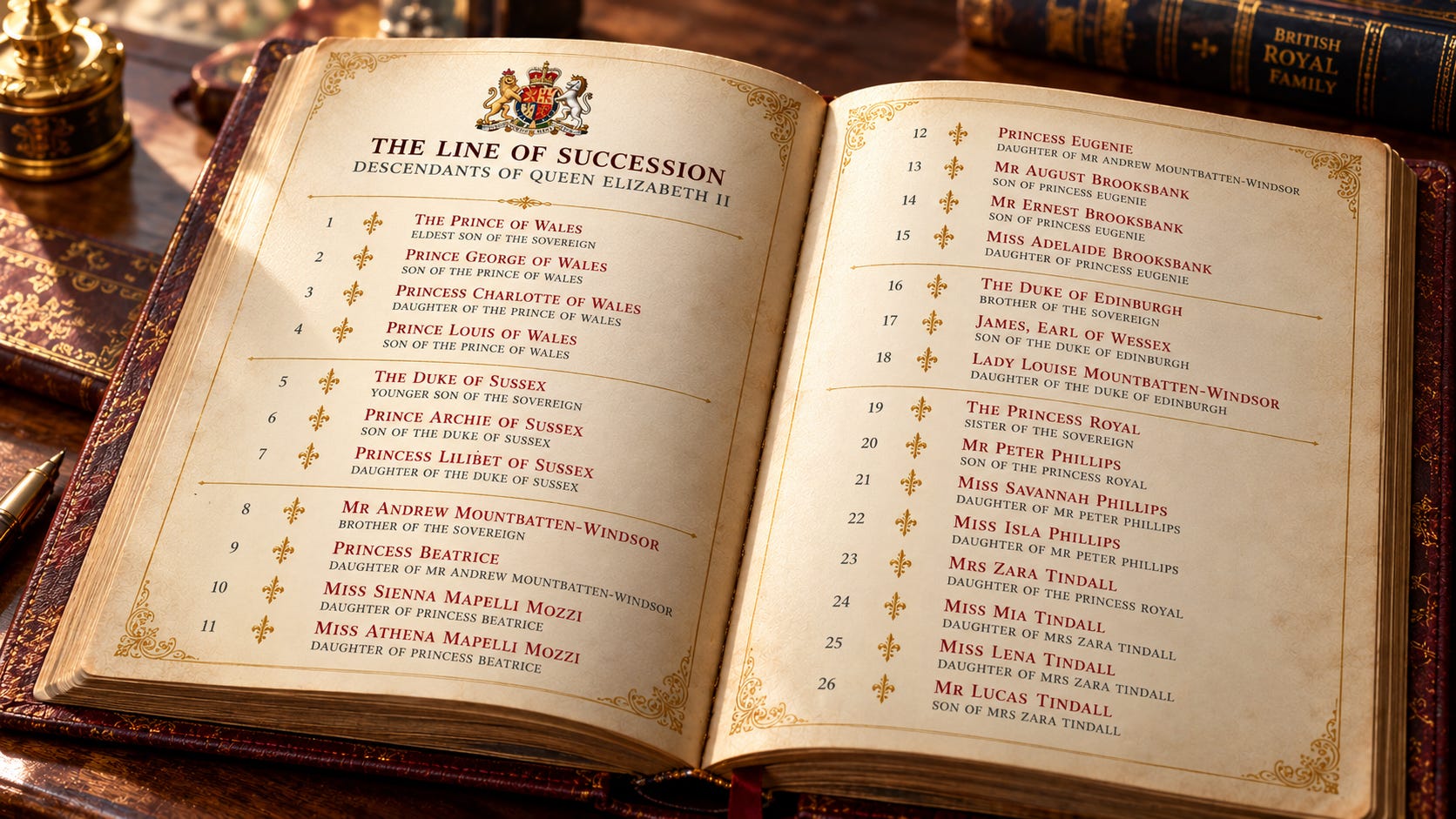
Look at the top of the British line of succession and you could be forgiven for thinking that it is simply a list of princes and princesses.
Prince William. Prince George. Princess Charlotte. Prince Louis. Prince Harry. Prince Archie. Princess Lilibet.
Then comes Andrew Mountbatten-Windsor, which is our first clue that things aren’t quite that simple.
Keep going and we find Princess Beatrice followed by her daughters, Sienna and Athena Mapelli Mozzi. Princess Eugenie is followed by August, Ernest and Adelaide Brooksbank.
Further down we find Peter Phillips, his daughters Savannah and Isla, and Zara Tindall with her children Mia, Lena and Lucas.
Most of those people don’t have royal titles. Some don’t have titles at all.
But every one of them is in line to become King or Queen.
That’s because the rules that determine who succeeds to the throne and the rules that determine who gets to be a prince or princess are two completely different things.
There’s a useful shorthand for remembering the difference.
Succession is largely about who your parents are.
Royal titles are usually about who your father is.
As we’ll see, there are qualifications and exceptions to both rules. But they explain a surprising amount about the modern Royal Family.
A family tree, not a list of titles
Your place in the line of succession doesn’t depend on whether you’re a prince, princess, duke, earl—or plain Mr or Miss.
It comes from your position in a family tree, subject to rules laid down in legislation.
The modern succession ultimately derives from the Act of Settlement 1701, which settled the Crown on the Protestant descendants of Sophia, Electress of Hanover. More recent legislation has changed some of the rules. In particular, the Succession to the Crown Act 2013 ended male-preference primogeniture for people born after 28 October 2011: a younger brother can no longer jump ahead of an older sister. It also removed the disqualification that resulted from marrying a Roman Catholic.
But none of this says that you have to be a prince or princess.
Consider Princess Anne.
Anne is currently nineteenth in line to the throne. Her son Peter Phillips is twentieth, followed by his daughters Savannah and Isla. Anne’s daughter Zara Tindall is twenty-third, followed by her three children.
None of those seven descendants of Anne has a royal title.
It doesn’t matter. Their places in the succession come through Anne.
Titles follow a different family tree.
Why Beatrice is a princess and Zara isn’t
The rules governing the titles Prince and Princess and the style Royal Highness largely date from Letters Patent issued by George V in 1917.
They gave those titles and styles to the children of the Sovereign and to the children of the sons of the Sovereign. There was also a special provision for the eldest living son of the eldest son of the Prince of Wales.
That word sons is important.
When Prince Andrew had children, Beatrice and Eugenie were grandchildren of Queen Elizabeth II through one of her sons. They therefore became Princess Beatrice and Princess Eugenie.
When Princess Anne had children, Peter and Zara were also grandchildren of Queen Elizabeth II.
But they were grandchildren through one of her daughters.
So the 1917 Letters Patent didn’t make them Prince Peter and Princess Zara.
And we can now see the same thing happening in the next generation.
Princess Beatrice’s daughters, Sienna and Athena, follow their mother in the succession, but they don’t inherit British royal titles through her. The same is true of Princess Eugenie’s children.
So we get the apparently curious sequence:
Princess Beatrice → Sienna Mapelli Mozzi → Athena Mapelli Mozzi → Princess Eugenie → August Brooksbank → Ernest Brooksbank → Adelaide Brooksbank.
All seven are in the line of succession.
Only two are princesses.
The titles Peter and Zara could have had
Peter and Zara Phillips provide another useful complication, because royal titles aren’t the only titles available in Britain.
When Princess Anne married Mark Phillips in 1973, he was reportedly offered an earldom, as was customary for an untitled man marrying a princess, but he and Anne declined it.
Had Mark become an earl, it still wouldn’t have made his children Prince Peter and Princess Zara. Their mother’s royal status couldn’t transmit those titles to them under the 1917 rules.
But they could have received noble titles or courtesy styles through their father.
Instead, they grew up simply as Peter and Zara Phillips.
Anne has subsequently said that she thought the decision not to give her children titles was probably the right one.
Once again, none of this affected the succession.
Whether Mark Phillips was a commoner or an earl, his children were still the grandchildren of the Queen through Princess Anne.
The prince and princess who don’t use the titles
Prince Edward’s children demonstrate yet another distinction.
Edward is a son of Queen Elizabeth II. Therefore, under the 1917 Letters Patent, his children fall within the male-line grandchildren of a Sovereign who are entitled to be Prince or Princess and Royal Highness.
But when Edward married Sophie Rhys-Jones in 1999, it was announced that their children would be styled as the children of an earl rather than as prince or princess.
And that’s how they have always been known.
Their daughter is Lady Louise Mountbatten-Windsor. Their son is now James, Earl of Wessex.
The underlying Letters Patent weren’t rewritten for Louise and James. The family simply chose not to use the royal titles to which the 1917 rules would otherwise entitle them.
That gives us another distinction.
You can be entitled to a royal title without using it.
And, inevitably, their choice of title has no effect on the succession. James is currently seventeenth and Louise eighteenth.
Then the rules met Princess Charlotte
By the early 2010s, however, the difference between the rules of succession and the rules for titles was about to produce a particularly strange result.
William and Catherine were expecting their first child.
At the same time, the rules of succession were being changed so that their eldest child would remain ahead of any younger siblings regardless of sex.
But the 1917 Letters Patent still contained that very specific provision about the eldest living son of the eldest son of the Prince of Wales.
If William’s first child had been a girl, she could therefore have been directly in line to the throne without automatically being a princess under the existing rules.
And if she subsequently acquired a younger brother, the new succession rules would have kept her ahead of him — while the old rules on titles treated the boy differently.
Queen Elizabeth II dealt with the problem before George was born.
On 31 December 2012 she issued new Letters Patent, extending the title Prince or Princess and the style Royal Highness to all the children of the eldest son of the Prince of Wales.
As it happened, the first child was a boy anyway: Prince George.
But the change mattered when his sister was born.
Princess Charlotte was a princess from birth. And, following the commencement of the Succession to the Crown Act 2013, the birth of her younger brother Louis didn’t push her down the line of succession.
Two different sets of rules had been modernised at almost exactly the same time.
Archie and Lilibet had to wait
Prince Harry’s children show the 1917 rules working in a different way.
When Archie Mountbatten-Windsor was born in 2019, he was seventh in line to the throne.
But he wasn’t Prince Archie.
His place in the succession came through his father, Prince Harry.
His title was a different question.
Harry was then a grandson of the reigning Sovereign. That made Archie a great-grandchild of Queen Elizabeth II — one generation too far away to qualify as a prince under the general 1917 rules.
And the 2012 change didn’t apply to him. It specifically covered William’s children.
The same was true when Lilibet Mountbatten-Windsor was born in 2021.
Then, on 8 September 2022, Queen Elizabeth II died.
Charles III immediately became King.
Nothing changed about Archie’s parents. Nothing changed about Lilibet’s parents. Their places in the family tree didn’t change.
But something important had changed in that family tree: their grandfather was now a Sovereign.
Until that moment, Archie and Lilibet had been great-grandchildren of a Sovereign, descended through her grandson Harry. That put them one generation beyond the general provisions of the 1917 Letters Patent.
With Charles’s accession, they became grandchildren of a Sovereign through one of his sons.
And that brought them within the 1917 Letters Patent.
They were now entitled to be Prince Archie of Sussex and Princess Lilibet of Sussex. Those titles weren’t publicly used immediately, but they are now the names under which the Royal Family officially lists them.
It’s perhaps the neatest demonstration of the difference between the two systems.
Their succession rights didn’t suddenly appear when their grandfather became King.
Their entitlement to royal titles did.
There’s an exception to the father rule
All of this might make it sound as though royal titles can only descend through fathers.
They can’t — and the exception is important.
The 1917 Letters Patent also give the titles Prince and Princess to the children of the Sovereign.
And sometimes the Sovereign is a woman.
There’s a lovely example in the late Queen’s own family.
When Charles was born in 1948, his mother was not yet Queen Elizabeth II. She was Princess Elizabeth.
Under the ordinary 1917 rules, her children wouldn’t have qualified as Prince or Princess through her because she was a daughter of the Sovereign rather than a son.
So George VI issued special Letters Patent in 1948 granting Elizabeth and Philip’s children the title Prince or Princess and the style Royal Highness.
When Elizabeth became Queen in 1952, the special provision ceased to make any practical difference. Charles and Anne were now children of the Sovereign and qualified under the normal 1917 rules anyway.
So our shorthand needs a small footnote:
Royal titles usually follow the male line — unless your mother happens to be the Queen.
And then there’s Andrew
Finally, we have an example that approaches the question from the opposite direction.
Andrew was born HRH Prince Andrew in 1960, as a son of Queen Elizabeth II.
For decades he was also Duke of York.
Following the controversies surrounding his relationship with Jeffrey Epstein, however, his royal status changed dramatically.
In November 2025, King Charles III issued Letters Patent declaring that Andrew would no longer be entitled to the style Royal Highness or the title Prince. His Duke of York title was removed from the Roll of the Peerage and is no longer used officially, although the peerage itself has not legally been extinguished.
He is now Andrew Mountbatten-Windsor.
But look at the line of succession.
He’s still there.
Number eight.
His royal title has gone.
His place in the succession hasn’t.
That’s because the King could use his powers to change Andrew’s royal title. Changing the statutory succession is a different constitutional matter involving Parliament and, by convention, the other Commonwealth realms that share the same monarch.
And, intriguingly, Andrew’s daughters haven’t lost anything.
Beatrice and Eugenie are still princesses. They are still in the succession. Their father’s loss of his title didn’t rewrite the 1917 Letters Patent retrospectively, and it didn’t alter who their grandparents were.
Two systems, one family tree
So perhaps we shouldn’t think of the line of succession as a list of royal people ranked in order of importance.
It isn’t.
Nor should we assume that Prince, Princess, Duke, Earl, Lady, Mr and Miss tell us anything useful about someone’s chances of inheriting the Crown.
They don’t.
The current official list makes the point beautifully. It runs from the Prince of Wales through princes and princesses, an untitled former prince, daughters of princesses with no British titles, children using courtesy titles, and completely untitled descendants of the Princess Royal.
The two systems are answering different questions.
For succession, the important question is essentially:
Who are your ancestors, and do you satisfy the legal rules governing succession?
For a royal title, the question is more like:
How are you descended from a Sovereign, through which line, and what do the relevant Letters Patent say?
That’s why Peter Phillips can be twentieth in line to the throne without ever having been a prince.
It’s why Lady Louise can be entitled to a royal style that she doesn’t use.
It’s why Archie could be seventh in line without being a prince, and then become a prince without doing anything at all.
And it’s why Andrew Mountbatten-Windsor could stop being a prince while remaining eighth in line to become King.
The titles can come.
The titles can go.
The family tree remains.