

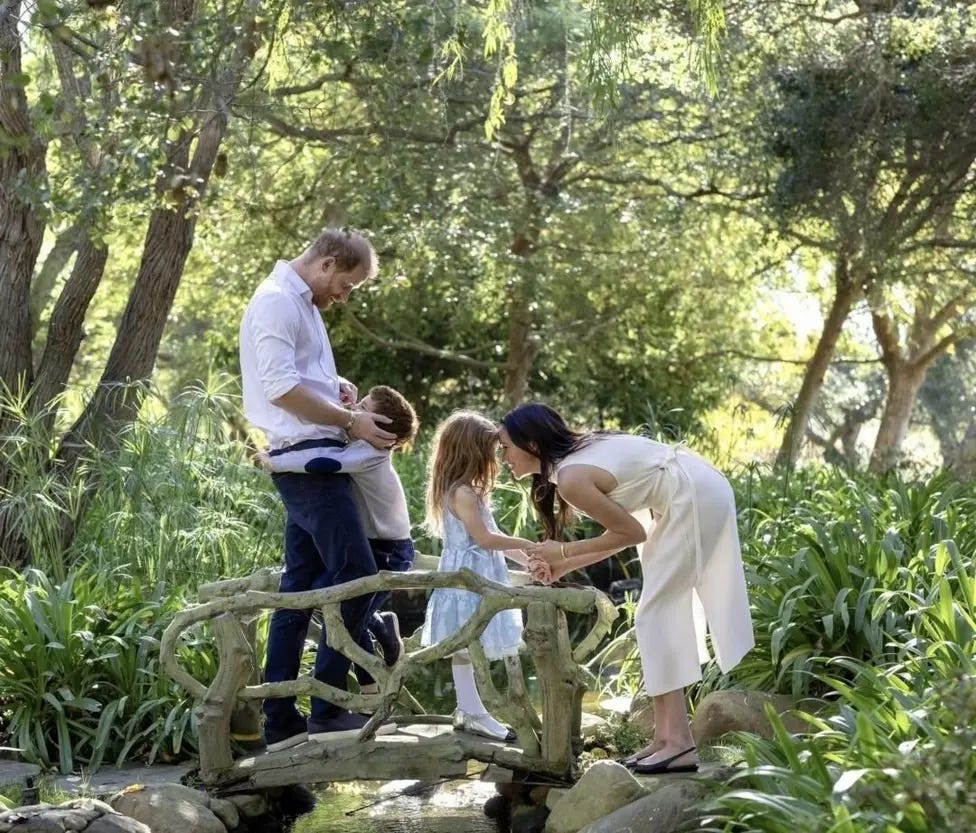
In recent years, a small but persistent strain of online commentary has sought to question the existence of the children of Prince Harry, Duke of Sussex and Meghan, Duchess of Sussex, namely Prince Archie of Sussex and Princess Lilibet of Sussex. While such claims are not grounded in credible evidence, they offer an opportunity to reflect on how we evaluate information, evidence, and plausibility in the modern age.
Rather than engaging with speculation directly, it is more constructive to examine the internal logic required to sustain such theories. When one does so, three simple questions emerge—each of which reveals the claims to be fundamentally untenable.
What would be gained?
Any serious allegation must begin with motive. What, precisely, would the Duke and Duchess of Sussex gain from such an elaborate deception?
Since stepping back from official royal duties in 2020, the couple no longer operate within the framework of the working monarchy. They do not receive public funding through the Sovereign Grant, nor do their current professional endeavours depend upon fabricating heirs. Indeed, their public roles—spanning media, philanthropy, and publishing—are entirely independent of such considerations.
Conversely, the risks associated with such a scheme would be immense. One would have to assume a willingness to jeopardise reputations, invite legal consequences in both the United Kingdom and the United States, and sustain a deception involving numerous professionals and institutions. It is difficult to identify any plausible benefit that could justify such extraordinary risk.
What would be the endgame?
Equally revealing is the absence of a coherent objective. For a conspiracy of this magnitude to function, it must lead somewhere, yet no convincing endgame is ever articulated.
The children occupy positions in the line of succession, but they are not in immediate proximity to the throne. Their existence confers no meaningful constitutional advantage that could not be achieved through entirely legitimate means. Nor does the notion of “publicity” withstand scrutiny; public attention is neither scarce nor dependent upon such fabrications.
A theory without a clear and rational conclusion is not a strategy—it is an assertion without structure.
Must others be complicit - or deceived?
Perhaps the most telling question is this: who else must be involved?
To deny the existence of Archie and Lilibet is, by necessity, to implicate others. One must accept either that the royal family is complicit in maintaining a falsehood or that it has been successfully deceived.
The first proposition would require the participation of senior figures, including Charles III, as well as the late Elizabeth II, both of whom publicly acknowledged the children. It would further imply the involvement of palace officials, medical professionals, and government authorities across two countries - all maintaining perfect secrecy.
The alternative - that the royal household has been misled - is no more plausible. Royal births are subject to formal procedures, legal registration, and multiple layers of verification. To sustain such a deception over several years would require bypassing systems designed precisely to prevent such occurrences.
In either case, the theory demands a chain of increasingly improbable assumptions, none of which are supported by evidence.
Addressing Common Claims
While it is neither necessary nor particularly helpful to catalogue every rumour, a small number of frequently repeated claims may be addressed briefly, as they tend to reflect broader misunderstandings rather than substantive evidence.
One such claim concerns the relatively limited number of publicly released photographs of Prince Archie of Sussex and Princess Lilibet of Sussex. This is sometimes presented as suspicious. In reality, it reflects a conscious decision by Prince Harry, Duke of Sussex and Meghan, Duchess of Sussex to afford their children a greater degree of privacy than is customary for senior working royals. Such an approach may differ from recent precedent, but it is neither unprecedented nor improper.
A further line of argument points to perceived irregularities in announcements or procedures surrounding the births. Yet royal practices have never been entirely static. While tradition once dictated highly formalised announcements within the United Kingdom, the circumstances of the Sussex family, particularly the birth of Lilibet in the United States, naturally involved different legal and administrative processes. In both cases, however, the essential requirements of birth registration and medical certification were fulfilled in accordance with the relevant authorities.
Occasionally, claims are also made on the basis of photographic or video material, with ordinary variations in appearance, perspective, or timing interpreted as inconsistencies. Such interpretations tend to rely on selective readings of visual media rather than verifiable facts, and they overlook the well-established limitations of drawing firm conclusions from isolated images.
Taken together, these claims share a common characteristic: they arise not from contradictory evidence, but from gaps in visibility, differences in expectation, or misunderstandings of procedure. When placed in proper context, they do not substantiate the conclusions drawn from them.
In this light, it becomes clear that such arguments do not meaningfully challenge the substantial body of formal documentation and institutional acknowledgement outlined above. Rather, they illustrate how easily conjecture can take root in the absence of full visibility—particularly when that absence is the result of deliberate and entirely legitimate choices regarding privacy.
A question of evidence
Against these conjectures stands a straightforward body of verifiable fact: official birth registrations, medical documentation, public acknowledgements by senior royals, and consistent reporting across reputable sources. While the Duke and Duchess of Sussex have chosen a more private approach to family life than some of their relatives, privacy is not evidence of absence.
Conclusion
Conspiracy theories often endure not because they are persuasive, but because they resist disproof within their own framework. Yet when examined through the lens of motive, structure, and institutional reality, the claims surrounding the Sussex children collapse under their own weight.
In the end, the matter is rather simple. Extraordinary claims require extraordinary evidence. In this instance, there is none—only speculation, sustained in the absence of reason.
A more measured approach—grounded in evidence, proportion, and common sense—leads to a far more credible conclusion.