

Over the weekend, the Mail on Sunday published extracts from a forthcoming book by royal journalist Tom Sykes, suggesting that the Prince of Wales is considering a significant overhaul of the British monarchy when he becomes king.
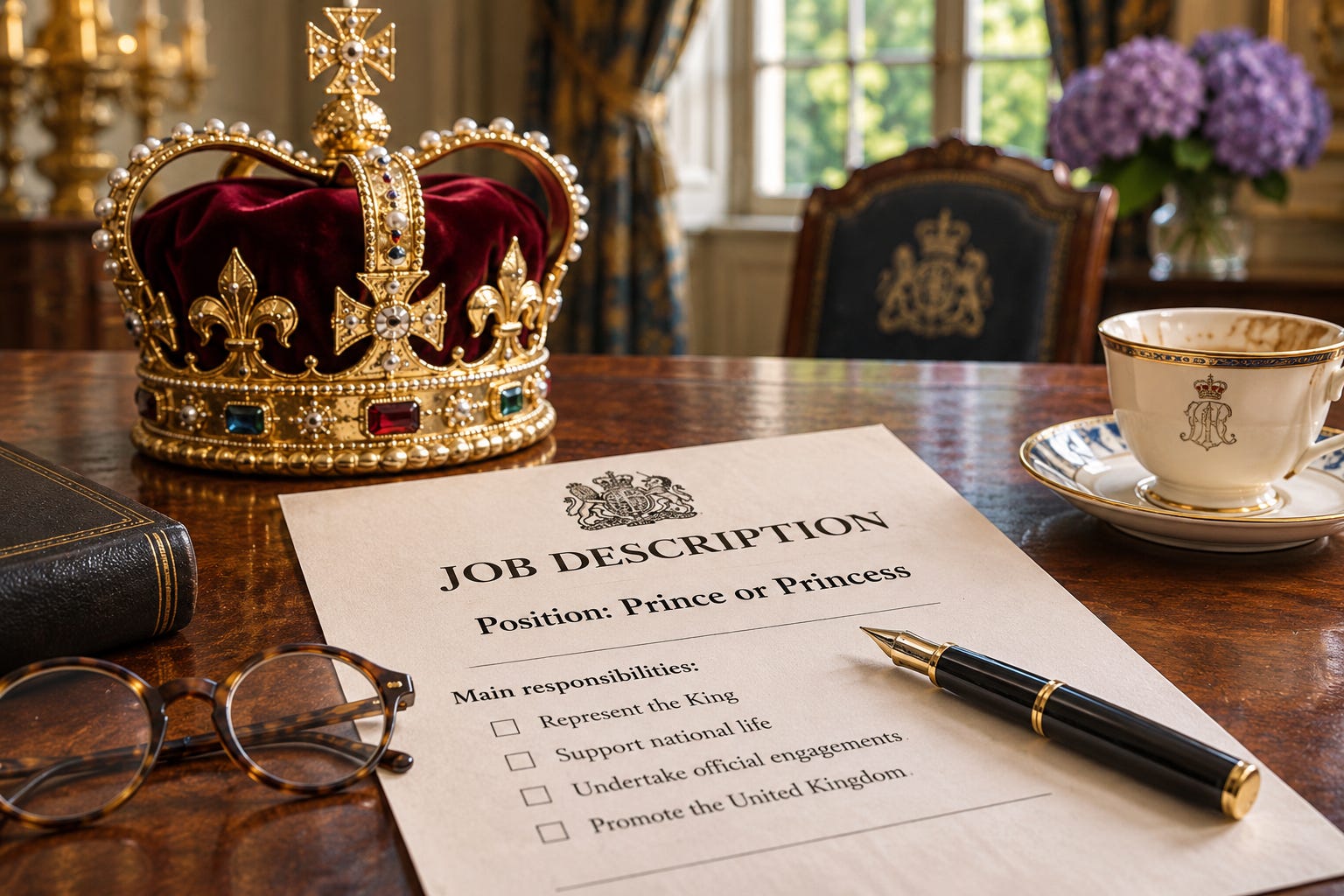
Among the reported proposals is a change to the way royal titles are allocated. Under the new system, the titles of prince and princess, together with the style of His or Her Royal Highness (HRH), would be reserved for working members of the Royal Family.
Much of the subsequent coverage has, inevitably, concentrated on what this might mean for the Duke and Duchess of Sussex and their children. But the implications are potentially far wider than that.
Kensington Palace has reportedly disputed the claims, and no such policy has been announced. We should therefore treat this as a hypothetical proposal rather than a statement of William’s intentions.
But it’s an interesting proposal to examine on its own merits. Should being a prince or princess tell us something about what someone does, rather than who they are?
How do you become a prince or princess?
The rules governing who is entitled to be a British prince or princess are largely set out in Letters Patent issued by George V in 1917.
Under those rules, the titles of prince and princess, together with the style of HRH, were granted automatically to:
The children of the sovereign.
The children of the sons of the sovereign.
The eldest living son of the eldest son of the Prince of Wales.
Elizabeth II modified these rules in December 2012, extending the entitlement in that final category to all the children of the eldest son of the Prince of Wales, rather than just his eldest son.
This is why Charlotte and Louis were born a princess and a prince respectively, rather than becoming one when their grandfather became king in September 2022.
It’s also why Archie and Lilibet, who were not born a prince and princess, became entitled to those titles on exactly the same day.
The important thing to notice about these rules is that they say nothing about what the recipients of these titles are expected to do. There is no requirement to undertake royal engagements, to represent the sovereign or even to live in the United Kingdom.
The titles describe an individual’s relationship to the sovereign. They are not job descriptions.
Being royal and working royal
We already have a distinction, albeit a sometimes rather poorly defined one, between being a member of the Royal Family and being a working member of the Royal Family.
Princess Beatrice and Princess Eugenie, for example, are princesses by virtue of being granddaughters of Elizabeth II through one of her sons. Neither is a working royal in the generally accepted sense of the term. Both have pursued independent careers.
There is nothing unusual about this. Throughout much of the twentieth century, various members of the extended Royal Family held princely titles whilst living largely private lives.
Conversely, Vice Admiral Sir Timothy Laurence has frequently supported his wife, the Princess Royal, at royal engagements without ever becoming a prince.
We might also consider the late Duchess of Kent, who withdrew from most royal duties, stopped using her HRH style and spent years teaching music in a primary school. She remained the Duchess of Kent.
There has never been a necessary connection between holding a royal title and undertaking royal duties.
And, importantly, holding a royal title does not automatically entitle someone to public funding, police protection, a royal residence or the right to represent the sovereign. These are all separate matters, determined in different ways.
We already have two distinct concepts. What would we gain by combining them?
Following the idea to its logical conclusion
Imagine that we were designing a system from scratch in which the titles of prince and princess were reserved for working royals.
We would immediately find ourselves having to make some rather interesting decisions.
What would we do about children? Prince George, Princess Charlotte and Prince Louis are presumably not expected to be full-time working royals for many years. Would they have to wait until they started undertaking official engagements before acquiring their titles?
If we made an exception for children, at what age would that exception cease to apply? Would Charlotte and Louis find themselves having to choose between retaining their titles and pursuing careers of their own?
And what about the other end of a working life?
The Duke of Edinburgh retired from royal duties in 2017 at the age of 96. Under a strict interpretation of the proposed rules, would he have ceased to be a prince?
Would someone who was forced to withdraw from royal duties because of ill health also lose their title? Would they regain it if they recovered sufficiently to return to work?
How would we deal with someone who wanted to combine a professional career with a limited programme of royal engagements? Would there be a minimum number of engagements required each year in order to remain a prince or princess?
And what about spouses? Would marrying a working royal confer a royal title, as it generally does for the wife of a prince today, or would the spouse have to qualify through their own work?
None of these questions is necessarily unanswerable. But each would require another rule, another exception or another exercise of the sovereign’s discretion.
What initially sounds like an admirably simple reform could rather quickly become a surprisingly complicated system.
What have other monarchies done?
Britain is far from the only European monarchy to be considering how many of its members should have royal titles or undertake official duties.
In Denmark, Queen Margrethe II announced in 2022 that the four children of her younger son, Prince Joachim, would cease to be princes and princesses at the beginning of the following year. They would instead be known as counts and countesses of Monpezat.
The stated intention was to give them greater freedom to shape their own lives, without the expectations and obligations associated with membership of the Royal House. Nevertheless, the decision caused considerable unhappiness within the Danish Royal Family.
Sweden took a slightly different approach in 2019.
King Carl XVI Gustaf announced that five of his grandchildren would cease to be members of the Royal House, although they would remain members of the Royal Family. They would no longer be styled Royal Highness, and would not be expected to undertake official duties on behalf of the monarch.
Crucially, however, they retained their titles of prince and princess.
The Netherlands also makes a formal distinction between the Royal Family and the Royal House, with membership of the latter defined by legislation.
These examples illustrate that there is more than one way to address the problem of a growing royal family. And the Swedish example, in particular, demonstrates that it is possible to separate membership of the royal institution from membership of the royal family without taking away princely titles.
What problem are we trying to solve?
Before changing any system, it’s usually worth establishing precisely what is wrong with the existing one.
When people argue that non-working members of the Royal Family should lose their titles, what is it about the current arrangements that they actually object to?
If the concern is that too many people are being supported at public expense, then the rules governing public funding can be changed.
If the concern is that members of the Royal Family might exploit their royal connections for commercial gain, then we should consider how commercial activities and claims of royal endorsement can be regulated.
If there is confusion about whether someone is acting on behalf of the sovereign or in a private capacity, then the distinction between official and private activities needs to be made clearer.
None of these problems is necessarily solved by removing someone’s royal title.
Indeed, removing a title does very little to remove the royal connection that gave rise to it. If Harry ceased to be a prince when William became king, he would still be the brother of the king. Beatrice and Eugenie would still be granddaughters of Elizabeth II.
Their family connections would continue to be of interest to the media and, potentially, to commercial organisations, regardless of the titles they were entitled to use.
There is also a risk that we would be creating the very problem we are trying to solve. If we establish a formal link between being a prince or princess and undertaking official duties, we reinforce the impression that a royal title automatically implies a public role.
At present, it doesn’t.
Changing the rules without taking titles away
There is another aspect of this discussion that deserves rather more attention than it generally receives.
Changing the rules governing who is entitled to a royal title does not necessarily require removing titles from people who already hold them.
These are two entirely separate decisions.
A future monarch could decide, for example, that princely titles should no longer be granted automatically to the grandchildren of the sovereign. New Letters Patent could establish that rule whilst explicitly preserving the titles and styles of existing princes and princesses.
George V’s reforms in 1917 were not entirely prospective, and we have seen more recent examples of the sovereign removing an individual’s princely title. But the fact that a monarch can do something does not mean that every reform requires them to do it.
We have already seen a more gradual approach within the British Royal Family.
When Prince Edward married Sophie Rhys-Jones in 1999, it was announced that any children they had would be styled as the children of an earl rather than as princes or princesses.
This did not lead to Beatrice and Eugenie, who had been born a decade earlier in broadly equivalent circumstances, ceasing to be princesses.
Strictly speaking, the arrangements for Edward and Sophie’s children concern the use of titles rather than a formal amendment to the 1917 rules. But they illustrate how a change in practice can be introduced without requiring everyone who came before it to conform retrospectively.
A gradual reduction in the number of titled members of the Royal Family might take a generation or two to achieve its full effect.
But is that really a problem? The monarchy is an institution accustomed to thinking in generations rather than electoral cycles. It can afford to take a long-term view.
And introducing changes prospectively has the considerable advantage of making them look like institutional reform rather than the punishment of particular individuals.
A monarch who wants fewer princes and princesses in the future need not take titles away from the princes and princesses of today. They can simply change the rules under which new ones acquire their titles.
A family and an institution
Perhaps the most useful reform would be to establish a clearer, more formal distinction between the British Royal Family and the working monarchy.
We might even borrow the terminology used elsewhere in Europe and distinguish between the Royal Family and the Royal House.
Membership of the Royal Family would be determined by birth and marriage. Membership of the Royal House would be determined by the sovereign and would reflect an individual’s official responsibilities.
We could, if we wanted to go further, consider whether the style of Royal Highness should be associated with membership of the Royal House, whilst the titles of prince and princess remained indicative of family relationships. And, again, any such change could preserve the styles of those already entitled to them.
The precise boundaries would be a matter for debate. But the underlying principle would be that what someone does for the monarchy is a separate question from how they are related to the monarch.
This would also allow the institution to respond more flexibly to changing circumstances. Members of the Royal Family could take on official responsibilities when they were needed, and relinquish them when they were no longer able or willing to undertake them, without requiring a change to their names and titles every time their circumstances changed.
A slimmed-down monarchy does not necessarily require a slimmed-down Royal Family.
So, should royal titles be a job description?
I don’t think they should.
There is nothing inherently contradictory about being a princess and having a career in business, any more than there is about being a prince and a retired naval officer.
If we want fewer people to hold royal titles in the future, we can change the rules governing their acquisition. If we want fewer people carrying out royal duties, we can reduce the size of the working monarchy. If we want greater clarity about the distinction between public duties and private activities, we can establish clearer rules governing those activities.
These are all perfectly reasonable ambitions. But they are different ambitions, and there is no reason why they all need to be achieved through the same mechanism.
The Royal Family is a family. The working monarchy is an institution. They overlap, but they are not the same thing.
Perhaps the answer is not to turn royal titles into job descriptions, but to become rather better at explaining the difference.