

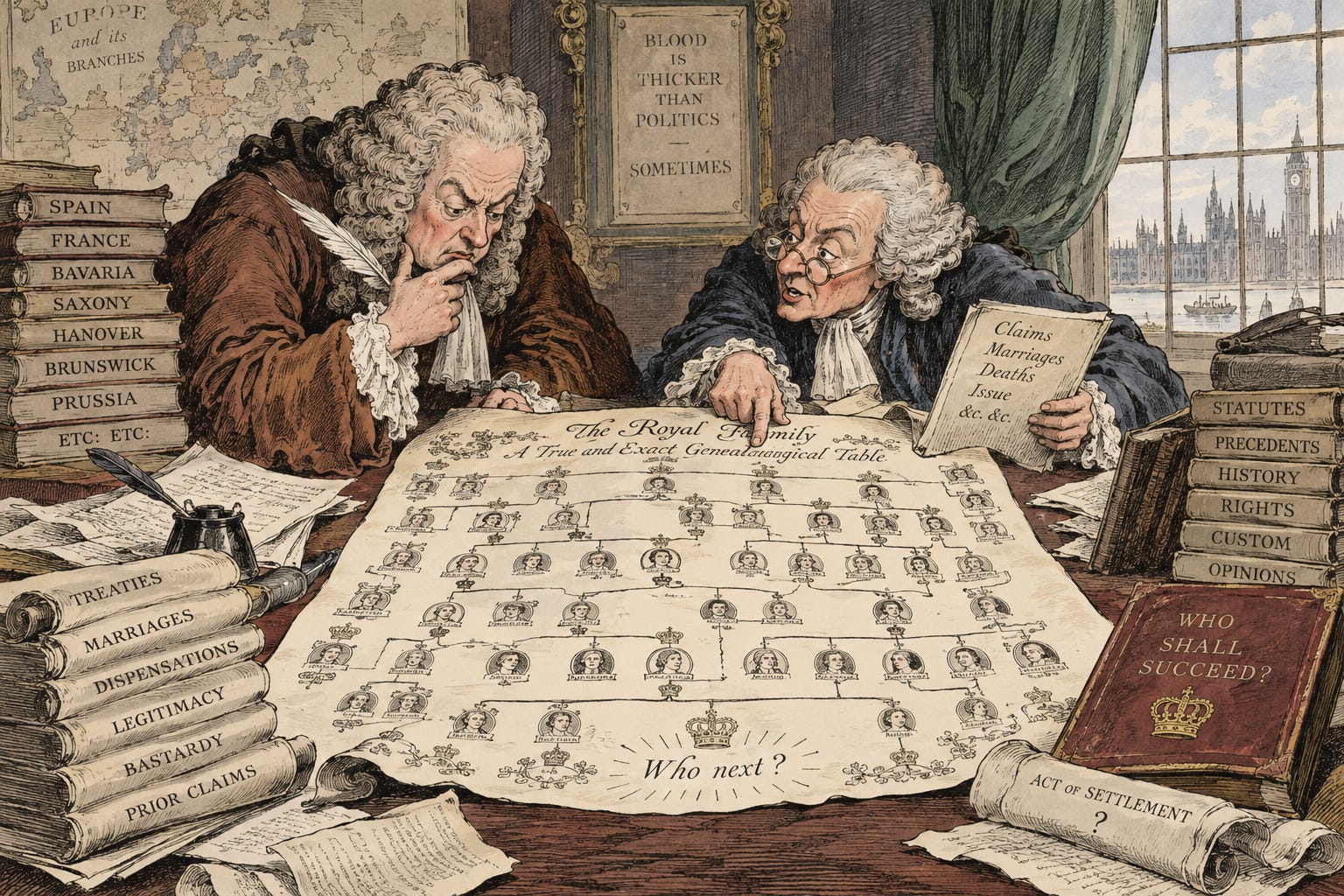
Scene One: The Search for an Heir: 1700–1701
Whitehall. Somewhere beneath an increasingly alarming pile of family trees.
Genealogist 1: Right. We have a problem.
Genealogist 2: The royal family has run out of heirs?
G1: Pretty much. King William III has no surviving children. Princess Anne has endured pregnancy after pregnancy, but her only child to survive infancy, Prince William, has just died aged eleven.
G2: So who’s next?
G1: That’s what the English Parliament would like us to sort out.
G2: What are the rules?
G1: We start with normal hereditary succession. But Parliament’s overriding requirement is that the Crown remains Protestant. No Catholics. No illegitimate children. And obviously no dead people.
G2: That last one seems unnecessary.
G1: You’d be surprised.
G2: Fine. Start with the closest relatives. Mary and Anne were daughters of James II. Did they have any brothers or sisters?
G1: Yes. There’s their half-brother, James Francis Edward Stuart.
G2: Excellent. Problem solved.
G1: Catholic.
G2: Ah. Anyone else from James II?
G1: Plenty of illegitimate children.
G2: Illegitimate.
G1: Exactly.
G2: So go back a generation. James II’s siblings?
G1: His older brother was Charles II.
G2: Children?
G1: Lots.
G2: Excellent!
G1: All illegitimate.
G2: Every single one?
G1: Every single one. That’s why James succeeded him.
G2: Next sibling.
G1: Mary, Princess Royal.
G2: Children?
G1: William III.
G2: Who is already king.
G1: And has no children.
G2: Next.
G1: Elizabeth.
G2: Children?
G1: Died aged fourteen.
G2: Next.
G1: Henry, Duke of Gloucester.
G2: Children?
G1: None.
G2: Next.
G1: Henrietta Anne.
G2: Now we’re getting somewhere.
G1: She married Philippe, Duke of Orléans, brother of Louis XIV of France.
G2: Children?
G1: Yes. Descendants too.
G2: Brilliant.
G1: Catholics.
G2: Of course they are.
G1: So we go back another generation, to the children of James I.
G2: Charles I we’ve already exhausted.
G1: Right. His older brother Henry died young and childless. Elizabeth, however, married Frederick V, Elector Palatine.
G2: Children?
G1: Thirteen.
G2: Thirteen! Surely we can find a Protestant somewhere in there.
G1: Now you’re thinking like Parliament.
G2: Work through them.
G1: Henry Frederick.
G2: Children?
G1: Drowned at fifteen.
G2: Next.
G1: Charles Louis.
G2: Descendants?
G1: Yes, but nothing there gives Parliament the secure Protestant succession it’s looking for.
G2: Hang on. So we’re not simply looking for the next person in strict hereditary order?
G1: Not any more. Parliament wants a Protestant line it can settle the Crown upon.
G2: So we’re not so much finding the heir as choosing where to route the succession.
G1: Now you’ve got it.
G2: This is beginning to feel less like royal succession and more like debugging a family tree.
G1: Welcome to seventeenth-century European genealogy.
G2: Keep going.
G1: Several more children. Some die young. Some have no legitimate descendants. Some marry Catholics or produce Catholic lines.
G2: Who have we got left?
G1: Elizabeth’s twelfth child. Sophia.
G2: Sophia of...?
G1: Hanover. Born Sophia of the Palatinate. Granddaughter of James I of England and VI of Scotland.
G2: Protestant?
G1: Very.
G2: Legitimate?
G1: Yes.
G2: Alive?
G1: Yes.
G2: So she’s the heir?
G1: She’s the one we take to Parliament. We recommend settling the succession on Sophia and her Protestant descendants.
G2: And Parliament can just do that?
G1: That’s the plan. If they agree, the Act of Settlement will make it law.
G2: Excellent. Problem finally solved.
G1: For England, anyway.
G2: What does that mean?
G1: Scotland has its own Parliament. And it hasn’t agreed to any of this.
G2: Is that going to be a problem?
G1: Let’s deal with one constitutional crisis at a time.
G2: Fair enough.
Scene Two: Thirteen Years Later: 1714
The paperwork has survived. Not everyone else has.
G2: Morning. Anything happen while I was away?
G1: Sophia’s dead.
G2: Oh, come on.
G1: She died in June.
G2: Well, at least Queen Anne is still—
G1: She’s dead too.
G2: What?
G1: Less than eight weeks after Sophia.
G2: So we’re back to the list.
G1: Fortunately not. The Act of Settlement says Sophia and her Protestant descendants. Her eldest son is George, Elector of Hanover.
G2: Protestant?
G1: Yes.
G2: Legitimate?
G1: Yes.
G2: Alive?
G1: Yes.
G2: Is that genuinely all we’re asking by this point?
G1: More or less.
G2: How closely related is he to Anne?
G1: They’re second cousins. They share great-grandparents: James I and Anne of Denmark.
G2: And there really isn’t anyone more closely related?
G1: Oh, there are dozens of people more closely related.
G2: Then why aren’t we choosing one of them?
G1: Catholics.
G2: All of them?
G1: Around fifty people with stronger hereditary claims were passed over because they were Catholic.
G2: So George isn’t king because everyone looked at the royal family and decided he was the nearest relative.
G1: Exactly. He’s king because Parliament decided that the Crown must remain Protestant, then routed the succession through Sophia of Hanover and her Protestant descendants.
G2: And that’s how Britain gets a German king.
G1: A German king who is the great-grandson of James I and VI, yes.
G2: Seems a rather distant connection.
G1: Welcome to European royalty. Give me half an hour and I’ll show you how everyone in this room is related to everyone else.