

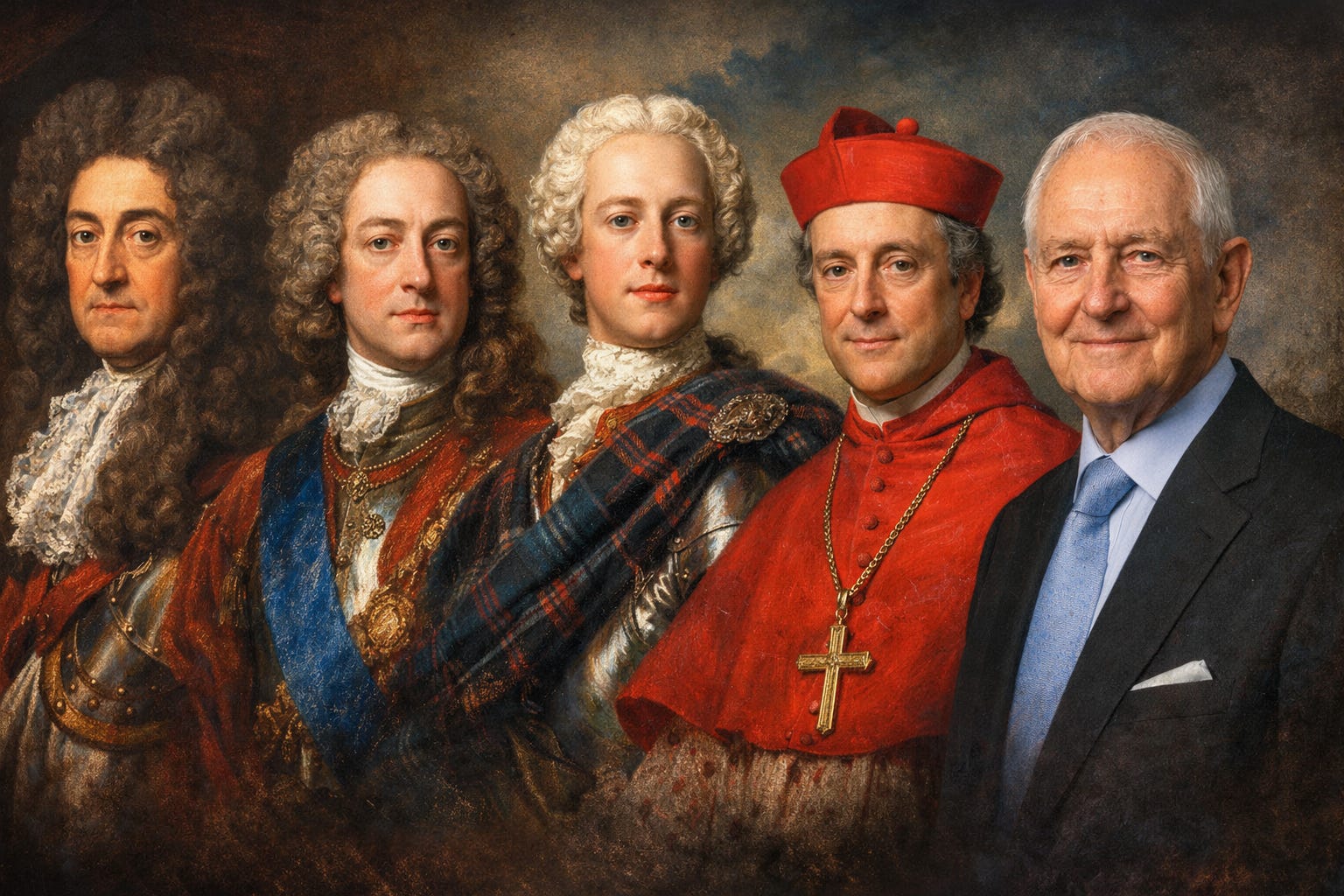
Here on Line of Succession we track the official order to the British throne — a carefully defined list determined by statute, religion, and centuries of constitutional practice. On paper, the line is straightforward. In reality, royal inheritance has rarely been so tidy.
History is full of moments when the succession might easily have taken a different turn. Depositions, disputed legitimacy, religious conflict, and parliamentary intervention have all reshaped the crown’s path at one time or another. For every officially recognised monarch, there are rival genealogies and intriguing “what if” claimants waiting in the wings.
This week we are stepping away from the official list to explore several of the most interesting alternative lines of succession. Some once commanded political movements and armies; others exist mainly as genealogical curiosities. All of them illustrate just how contingent the modern royal succession really is.
The Jacobite Succession
The best-known alternative royal line begins with the supporters of the deposed King James II of England.
In 1688 the Glorious Revolution removed James from the throne and replaced him with his Protestant daughter Mary II of England and her husband William III of England. Parliament subsequently reinforced the new constitutional settlement through measures such as the Bill of Rights 1689 and, crucially, the Act of Settlement 1701.
Jacobites rejected this settlement entirely. In their view, James II remained the lawful monarch and the crown should pass to his heirs regardless of religion.
The Jacobite line therefore ran through three principal Stuart claimants:
James Francis Edward Stuart
Charles Edward Stuart
Henry Benedict Stuart
The most dramatic moment of the Jacobite cause came during the Jacobite Rising of 1745, when Charles Edward Stuart led a Jacobite army as far south as Derby before retreating to Scotland, where the uprising ended in defeat at the Battle of Culloden.
When Henry Benedict Stuart died childless in 1807, the senior Stuart line ended. However, the theoretical hereditary claim continued through the descendants of Henrietta Anne Stuart and passed into a succession of European dynasties.
Today the senior heir of that line is Franz, Duke of Bavaria.
Under strict Jacobite principles he would theoretically be King Francis II of Great Britain and Ireland. In practice, however, such a claim would have no legal standing in the United Kingdom. The Act of Settlement 1701 restricts the crown to the Protestant descendants of Sophia of Hanover, meaning that even if the Duke of Bavaria wished to assert his hereditary claim, the existing constitutional settlement would invalidate it.
Like his predecessors in the Wittelsbach line, the Duke of Bavaria has never shown any interest in pursuing the matter.
The “Real King of Britain” in Australia
One of the more entertaining modern succession theories emerged from a 2004 documentary presented by Tony Robinson titled Britain’s Real Monarch.
The programme examined a controversial hypothesis about Edward IV of England. According to the theory, Edward may have been illegitimate because his supposed father, Richard, Duke of York, was allegedly campaigning in France at the time Edward was conceived.
If Edward IV were not the legitimate son of the Duke of York, the Yorkist claim would instead descend through his younger brother:
George Plantagenet, Duke of Clarence.
Following that line through the centuries eventually leads to an Australian aristocrat:
Michael Abney-Hastings.
At the time the documentary aired, Lord Loudoun lived in rural Victoria and worked as a forklift driver. The idea that Britain’s rightful monarch might be living quietly in Australia understandably captured the public imagination.
However, even if the historical theory were correct — something most historians doubt — the claim would still fail under modern constitutional law. The Act of Settlement 1701 determines the present royal succession, and it grants the crown exclusively to the Protestant descendants of Sophia of Hanover. Since the Abney-Hastings line descends through an entirely different branch of medieval royalty, any theoretical claim would be legally excluded.
Lord Loudoun died in 2012, and the earldom passed to his son:
Simon Abney-Hastings.
Under the same speculative theory, Simon would now occupy the position his father once held in that alternative genealogy. Like his father, he has treated the idea with good humour and has never pursued any form of royal claim.
The Australian Claimant to be Charles and Camilla’s Son
A very different sort of “alternative claimant” emerged in the twenty-first century with the assertions of Simon Charles Dorante-Day, an Australian man who claims to be the secret son of Charles III and Camilla, Queen Camilla.
Dorante-Day states that he was born in the 1960s and adopted shortly afterwards, alleging that his biological parents were the then Prince Charles and Camilla Shand. He has pursued legal action in Australia seeking DNA testing and official recognition of this alleged parentage.
No credible evidence has ever substantiated the claim, and historians and royal commentators consider it entirely unsupported. The timeline itself presents serious problems, as Charles and Camilla’s well-documented relationship did not begin until the early 1970s.
Of course, even if this claim were true, it would make no difference to the line of succession. Dorante-Day would be excluded as illegitimate, and the subsequent marriage of Charles and Camilla makes no difference to that.
Nevertheless, the story occasionally resurfaces online and in international media, reflecting the enduring fascination with royal lineage and the powerful allure of hidden heirs.
If the Line of Sophia of Hanover Failed
The modern British succession ultimately derives from a single individual:
Sophia of Hanover.
Under the Act of Settlement 1701, the crown was granted to Sophia and the “heirs of her body being Protestant.”
When the Act was passed, Sophia was actually far down the hereditary line descending from James I of England. Many individuals with stronger hereditary claims existed, but they were excluded because they were Roman Catholic.
Parliament, therefore, deliberately bypassed numerous senior lines and settled the crown on Sophia as the nearest acceptable Protestant heir.
This creates an intriguing genealogical puzzle. If every descendant of Sophia were somehow to die out, the Act of Settlement would effectively cease to operate. Parliament would once again have to legislate to determine the next monarch.
From a purely genealogical perspective, however, one must look further back in the royal family tree, because the Stuart descendants senior to Sophia were largely Catholic dynasties on the continent.
One of the earliest English royal figures whose line still has living descendants is:
Frances Brandon.
Frances was the granddaughter of Henry VII of England and the mother of the famous — and tragically short-lived — Lady Jane Grey.
Through her younger daughters, particularly Katherine Grey and Mary Grey, the Brandon line continued into numerous English aristocratic families. Those descendants survive today, meaning that if one searches far enough back through Tudor genealogy, the Brandon line provides one of the earliest surviving branches with living heirs.
Of course, none of this would determine the monarchy in practice. If Sophia’s line truly failed, the choice of the next monarch would almost certainly become a matter for Parliament rather than pure hereditary calculation — just as it did during the constitutional crises that produced the settlement of 1689 and 1701.
A Monarchy of “What Ifs”
The modern succession appears long, stable, and reassuringly clear. Thousands of descendants of Sophia of Hanover stand between the present day and any conceivable constitutional vacuum.
Yet the history of the British monarchy shows how often the royal line has been redirected by events: revolutions, religious conflict, disputed legitimacy, and acts of Parliament.
Had just a few moments in history unfolded differently, the British throne might today belong to a Bavarian duke, an Australian aristocrat, or an entirely different royal house.
For students of royal genealogy, these alternative successions serve as a reminder that the monarchy is not merely a list of names. It is a story shaped by politics, religion, and the unpredictable twists of history.
Did You Know?
The modern British line of succession is far longer than most people realise.
Because the crown is limited to the Protestant descendants of Sophia of Hanover under the Act of Settlement (1701), genealogists have traced thousands of eligible heirs.
Most estimates suggest there are well over 6,000 living people currently in the legal line of succession to the British throne.
Only the first couple of dozen names are widely published, but the list stretches deep into European and North American families — many of whom have little idea that they technically appear somewhere in the order of succession.
In theory, every one of those people would need to be excluded or die out before the succession could move beyond Sophia’s descendants and force Parliament to establish a new royal line.