

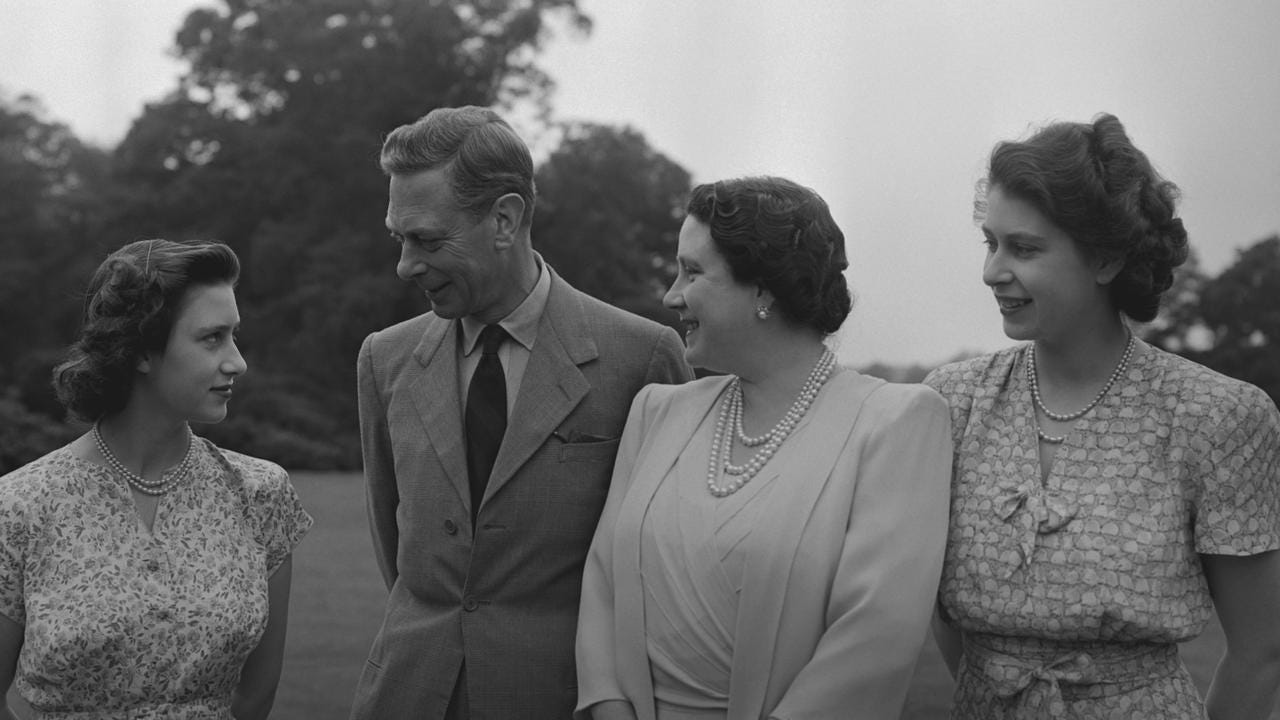
On 6 February 1952, Britain learned that the King had died.
The news did not come at dawn. It was not something people heard as they woke, nor did it break immediately after the death itself. Instead, it emerged later in the day, after a carefully managed sequence of confirmations and notifications had taken place. Only once the constitutional formalities were complete was the nation informed that George VI had died peacefully in his sleep at Sandringham House during the night.
The King passed away peacefully in his sleep during the night.
The official announcement was brief, dignified, and strikingly sparse. The cause of death was given as coronary thrombosis. No times were mentioned. No description of the circumstances was offered. No account was given of who was present, or when death occurred.
To contemporaries, this was normal. With hindsight, it marks the beginning of a story in which much was deliberately left unsaid.
From Death to Announcement
George VI died during the night of 5–6 February 1952 at Sandringham, his Norfolk estate. He was discovered dead in his bed during the morning, and medical confirmation followed.
What happened next explains why the announcement was delayed.
Before anything could be said publicly, several things had to occur in strict order. Senior members of the royal household were informed. Government ministers were notified. Most importantly, the heir to the throne had to be told.
Princess Elizabeth was at that moment in Kenya, early in a Commonwealth tour. A coded message was sent to relay the news. Only once she had been formally informed — and was therefore Queen — could a public announcement be made.
As a result, the news reached the British public later in the day, most commonly via lunchtime or early afternoon radio broadcasts and afternoon newspaper editions. There was no sense of haste or drama. This was a constitutional process unfolding at its own pace.
How the Death Was Reported
Between the initial announcement and subsequent Palace communiqués, three points were established:
the King had died peacefully in his sleep
the place was Sandringham House
the cause was coronary thrombosis
Nothing more was added.
The press treated the announcement with uniform restraint. Reports emphasised the King’s service, his wartime leadership, and the sudden accession of his daughter. There was no speculation about whether the death had been expected, and no reference to serious underlying illness.
From the public’s point of view, this appeared to be a sudden bereavement: the loss of a monarch who had looked frail, but who was believed to be recovering.
That impression was not accidental.
What We Now Know About the Final Night
Later historical work has made it possible to reconstruct the King’s final hours in outline, though not with absolute precision.
On the evening of 5 February 1952, George VI retired to bed at Sandringham at around 10 pm, following his usual routine. He read in bed and showed no signs of acute distress. The last person reliably recorded as seeing him alive was his valet, Alastair Scott, who attended him as normal before leaving him for the night.
The following morning, shortly after 7.30 am, Scott entered the King’s bedroom to wake him and discovered that he had died during the night. A doctor was summoned and death was formally confirmed.
There is no evidence that the King awoke during the night, summoned assistance, or experienced visible distress. All indications are that death occurred quietly during sleep, probably in the early hours of the morning.
None of these details were made public at the time. They appear only later, reconstructed carefully by historians from household routines, private papers, and secondary testimony. Importantly, they do not contradict the official statement — but they do add context that was originally absent.
At the time of the King’s death, his wife, the Queen (later known as Queen Elizabeth The Queen Mother), was not at Sandringham. She was in London, staying at Royal Lodge, having not accompanied the King on this visit. This was not unusual. By the early 1950s, the royal couple often travelled separately, particularly when the King was resting at Sandringham. She was informed privately later that morning, before any public announcement was made, and travelled to Sandringham afterwards. As with the delayed notification of Princess Elizabeth in Kenya, this separation underlines how the monarchy still functioned through routine, hierarchy, and process rather than immediate family presence.
The Illness Britain Was Not Told About
To understand why the King’s death appeared sudden, it is necessary to look back several months.
In September 1951, George VI underwent major surgery at Buckingham Palace. The operation was a left pneumonectomy: the complete removal of his left lung. It was performed by the distinguished surgeon Sir Clement Price Thomas.
The diagnosis was bronchial carcinoma — lung cancer.
This was not experimental surgery, but it was severe, even by the standards of the time. It carried substantial risk, and the long-term prognosis was poor. Recovery was difficult, and survival beyond a few years was uncertain at best.
The public was never told this.
Instead, Palace statements referred to an operation for a “structural abnormality” of the lung. The word “cancer” was carefully avoided. There was no suggestion that the illness was terminal or that the King’s life expectancy had been fundamentally altered.
This concealment was deliberate.
Why the Diagnosis Was Hidden
Several factors shaped the decision not to disclose the truth.
First, attitudes to cancer in the early 1950s were profoundly different from today. Cancer was widely regarded as a death sentence. Doctors often avoided using the term even with patients. Public disclosure by a head of state would have been seen as alarming and destabilising.
Second, there were constitutional considerations. Britain was still recovering from the Second World War, and the monarchy played an important symbolic role in national stability. A publicly dying King raised awkward questions about succession, regency, and preparedness. Princess Elizabeth was young and still being eased into public life as heir.
Third, there was image management. George VI’s public identity rested on stoicism and duty: the reluctant king who overcame a speech impediment, stayed in London during the Blitz, and embodied quiet resilience. A diagnosis of lung cancer — especially one strongly associated with smoking — risked undermining that carefully cultivated image.
Smoking and Silence
By modern standards, George VI was a heavy smoker for much of his adult life. Even by the late 1940s, doctors had urged him to cut down. He struggled to do so, including after surgery.
This connection between smoking and serious illness was never acknowledged publicly. While earlier photographs sometimes showed royals smoking, linking royal ill health to tobacco was unthinkable in contemporary reporting.
The Palace clearly had no desire for the King’s decline — or his death — to be framed as a cautionary tale.
Recovery as Performance
Following the lung operation, Palace bulletins spoke repeatedly of “excellent progress” and “continued improvement”. Appearances were carefully staged to reinforce this message. The King resumed some duties, though on a reduced scale.
Privately, the picture was very different.
His stamina never fully returned. He remained breathless and physically weakened. In addition to the effects of cancer surgery, he suffered from significant vascular disease. Those around him recognised that his health was fragile and that his life expectancy was limited, even if no precise timeline was discussed openly.
When he insisted on seeing Princess Elizabeth before her departure on a Commonwealth tour in January 1952, the meeting took on a significance that only later became apparent. In retrospect, it is clear that some within his circle feared this might be their last farewell.
Cause of Death and Emphasis
When George VI died, the cause given was coronary thrombosis. This was accurate. A clot in the coronary artery caused fatal cardiac failure.
What was not emphasised was the broader context: a body weakened by radical cancer surgery, burdened by vascular disease, and shaped by decades of heavy smoking.
The continued avoidance of cancer language after his death was consistent with the Palace’s earlier approach. Even in mourning, the narrative was carefully managed.
Press Deference and Public Trust
It is worth stressing that this concealment did not rely on censorship. The British press operated within a culture of deference to the monarchy. Editors did not investigate royal health aggressively, and there existed an informal understanding that certain matters were simply out of bounds.
This culture would erode dramatically in later decades. In 1952, it was still strong enough that an advanced cancer diagnosis could be kept from the public with little difficulty.
Why This Matters for the Succession
From today’s perspective, the management of George VI’s health can feel misleading. Yet it reflects its time: a period of paternalistic medicine, deferential journalism, and a monarchy deeply concerned with continuity.
What makes it historically significant is how effective the concealment was. The nation mourned a King whose death felt unexpected, even though his doctors had been managing terminal illness for months.
That gap between public perception and private reality shaped the emotional context of the accession of Elizabeth II, who became sovereign not amid anticipation, but sudden shock.
Conclusion
George VI did indeed die peacefully in his sleep. Nothing uncovered since alters that fundamental truth.
What has changed is our understanding of the path that led there: a serious cancer diagnosis concealed from the public, radical surgery minimised, illness framed in euphemism, and death announced only after constitutional necessities had been satisfied.
This was not scandal, nor deception in the modern sense, but a product of its era. It reminds us that royal history is shaped not only by what is proclaimed, but by what is deliberately left unsaid.
For a blog concerned with succession and constitutional continuity, the episode offers a quiet lesson: the transfer of the Crown is often far less transparent, and far more carefully managed, than the public announcement suggests.