

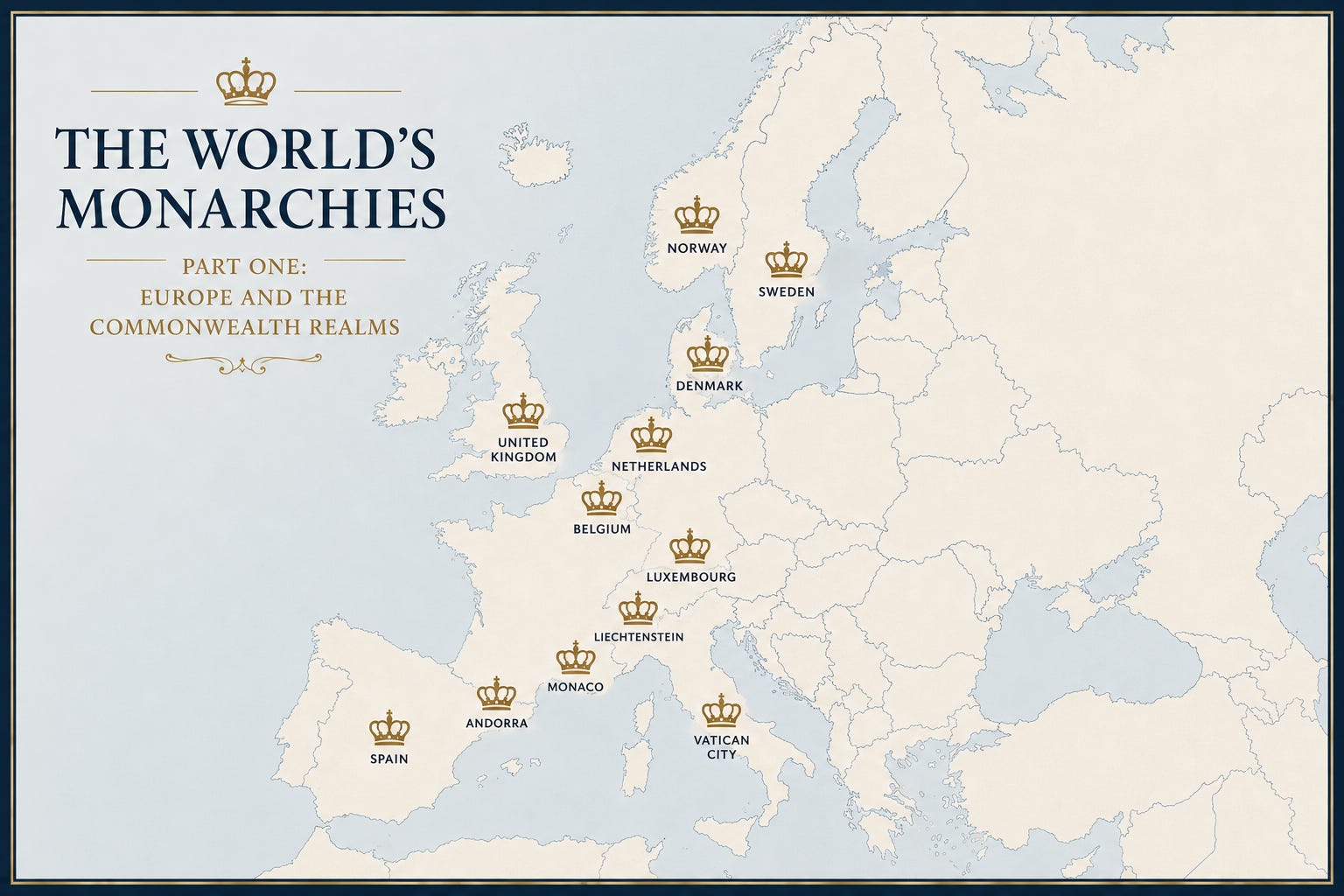
The death of King Harald V of Norway has brought to an end one of Europe’s longest and most admired modern reigns.
Harald died peacefully at Oslo University Hospital on 28 August 2026, aged 89. He had been King of Norway since 1991 and was, at the time of his death, Europe’s oldest reigning monarch.
His son has succeeded him as King Haakon VIII. On 1 September, the new King appeared before the Storting to take the oath required by Norway’s constitution, promising to govern in accordance with the country’s constitution and laws. His daughter, Crown Princess Ingrid Alexandra, is now first in line to the throne.
The succession marks more than a change of sovereign in Norway. It is another milestone in an extraordinary generational transformation of European royalty.
Queen Elizabeth II is gone. Queen Margrethe II of Denmark has abdicated, as have Queen Beatrix of the Netherlands, King Albert II of Belgium and King Juan Carlos I of Spain. Luxembourg changed sovereign in 2025.
Now Norway, too, has entered a new reign.
Yet monarchy itself has proved remarkably resilient.
Across Europe, royal houses which entered the twenty-first century looking to some like historical survivals have repeatedly demonstrated an ability to renew themselves. And beyond Europe, fourteen independent countries continue to share their monarch with the United Kingdom. King Charles III is sovereign of each of them separately, as well as serving as Head of the wider Commonwealth.
So, as Norway mourns one King and begins the reign of another, what has happened to Europe’s other monarchies since the beginning of the century — and what are their prospects for the decades ahead?
Norway: a new reign begins
King Harald V came to the throne on the death of his father, King Olav V, on 17 January 1991.
His was a characteristically Scandinavian reign: politically neutral, relatively informal and closely associated with a sense of national community. Harald was particularly remembered for the humanity he displayed at moments of national trauma, not least following the terrorist attacks in Oslo and on Utøya in 2011.
His later years were increasingly affected by ill health. In 2024, while holidaying in Malaysia, the King required a temporary pacemaker before returning to Norway, where a permanent device was fitted.
Nevertheless, Harald continued to reign until his death on 28 August.
His successor is King Haakon VIII, who at 53 begins the reign for which he has spent most of his adult life preparing.
The choice of regnal name carries considerable historical resonance. His great-grandfather, Haakon VII, was chosen as King when Norway became fully independent in 1905 and established the modern Norwegian royal house.
The new King has also retained the motto used by his predecessors: “All for Norway.”
The succession has simultaneously moved another generation forward.
Haakon’s 22-year-old daughter is now Crown Princess Ingrid Alexandra and heir apparent. Norway changed its constitution in 1990 so that the eldest child would inherit regardless of sex, although transitional provisions meant that Haakon retained precedence over his elder sister, Princess Märtha Louise. Ingrid Alexandra, born after the change, is not subject to that qualification.
If she eventually succeeds her father, she will become Norway’s first female monarch for more than six centuries.
The new reign does not begin without difficulties. The wider Royal Family has endured an unusually troubled period and considerably greater scrutiny than was customary during most of Harald’s reign.
Haakon’s task will therefore be to preserve perhaps his father’s greatest achievement: the idea that a hereditary Crown can sit comfortably within one of the world’s most egalitarian societies.
The future: the succession itself could hardly be clearer. The more interesting question is whether Haakon VIII can inherit the extraordinary reservoir of affection and trust accumulated by his father — and eventually hand a similarly secure monarchy to Ingrid Alexandra.
Denmark: an abdication that changed everything
On New Year’s Eve 2023, Queen Margrethe II astonished Denmark by announcing that she would abdicate.
She had reigned since 1972 and had repeatedly given the impression that hers would be a lifelong vocation. Yet on 14 January 2024, exactly 52 years after her accession, Margrethe signed her declaration of abdication.
Her elder son immediately became King Frederik X, with his Australian-born wife Mary becoming Queen. Their eldest son Christian became Crown Prince.
The transition was strikingly smooth.
That is important because abdication has become one of the great instruments of modern European monarchy. Rather than allowing an increasingly elderly sovereign to struggle indefinitely with public duties, several royal houses have used voluntary retirement to renew the institution.
What once seemed extraordinary — and, to British minds, carried uncomfortable echoes of Edward VIII — has become almost routine on the Continent.
The future: exceptionally strong. Frederik and Mary inherited considerable public goodwill, while Crown Prince Christian provides a clear next generation.
Sweden: waiting for Queen Victoria
Sweden has experienced no change of monarch this century.
King Carl XVI Gustaf has reigned since 1973 and is now one of the world’s longest-serving sovereigns.
But Sweden has already prepared for a very different future.
In 1980, it became the first monarchy to introduce absolute primogeniture, under which the eldest child inherits regardless of sex. That made the King’s eldest child, Crown Princess Victoria, heir instead of her younger brother Prince Carl Philip.
Victoria has therefore spent almost her entire life preparing to become Queen.
Behind her comes her daughter, Princess Estelle.
The future: secure. Sweden seems likely eventually to have two queens regnant in succession — Victoria followed, in due course, by Estelle.
It is part of a remarkable wider transformation.
The heirs in Sweden, Belgium, the Netherlands, Spain and now Norway are all women.
The middle decades of this century may consequently see European monarchy become noticeably more female than it has been at almost any previous point in its history.
The Netherlands: the Dutch tradition of stepping aside
Abdication is almost normal in the Netherlands.
Queen Wilhelmina abdicated in 1948. Queen Juliana followed her example in 1980. And in 2013 Queen Beatrix announced that, after 33 years on the throne, it was time for a new generation.
Her eldest son became King Willem-Alexander on 30 April 2013 — the Netherlands’ first king since Willem III died in 1890.
His eldest daughter, Catharina-Amalia, Princess of Orange, became heir.
The Dutch monarchy illustrates the principal difficulty facing many European crowns. Its survival is not seriously threatened by constitutional crisis. Instead, controversy tends to concern money, privilege and whether royal behaviour reflects the relatively modest role expected of a modern constitutional monarchy.
The future: reasonably strong. The succession is clear and the Dutch tradition of abdication makes generational change considerably easier.
Belgium: preparing for its first queen
Belgium also changed monarch in 2013.
King Albert II abdicated on 21 July, citing his age and health. His eldest son became King Philippe.
Philippe’s heir is his daughter, Princess Elisabeth, Duchess of Brabant.
Her eventual accession will make history. Belgium abolished male preference in the succession before Elisabeth’s birth, so she is expected to become the country’s first reigning queen.
Belgium also demonstrates one of monarchy’s less obvious uses.
In a country divided principally between Dutch-speaking Flanders and French-speaking Wallonia, with a smaller German-speaking community as well, the Crown provides an institution intended to stand outside both party politics and regional identity.
A president elected in a political contest might inevitably belong to one community or political tradition. A hereditary monarch can, at least in theory, belong equally to all of them.
The future: relatively strong. Elisabeth has been prepared for her constitutional role from childhood and represents another carefully managed generational transition.
Luxembourg: Europe’s newest reign
Until the events in Norway, Europe’s most recent hereditary royal succession had taken place in Luxembourg.
Grand Duke Henri, who had reigned since 2000, abdicated on 3 October 2025 in favour of his eldest son, Grand Duke Guillaume V. Guillaume became head of state after taking the constitutional oath before the Chamber of Deputies.
There was nothing particularly revolutionary about it.
Henri himself had become sovereign when his father, Grand Duke Jean, abdicated in 2000. Luxembourg has consequently embraced the idea that the throne can be handed to the next generation before the sovereign’s death.
The new Grand Duke and his wife, Grand Duchess Stéphanie, have two sons, providing another generation of succession.
The future: highly secure. Luxembourg demonstrates monarchy at its least dramatic — which may be one reason it works so effectively.
Spain: rebuilding after Juan Carlos
Spain entered this century with one of Europe’s most admired monarchs.
King Juan Carlos I was widely respected for his role in the transition from Franco’s dictatorship to democracy and particularly for his conduct during the attempted military coup of 1981.
Then his reputation collapsed.
Financial and personal controversies seriously damaged both Juan Carlos and the institution, and in June 2014 he abdicated.
His son became King Felipe VI, with the unenviable task of rebuilding confidence in the Crown.
Felipe’s reign has included the Catalan independence crisis and continued controversy surrounding his father. Yet attention has increasingly shifted towards his elder daughter, Princess Leonor, Princess of Asturias.
On her eighteenth birthday in 2023, Leonor swore allegiance to the Spanish Constitution before parliament — a major milestone in her preparation to reign.
Curiously, Spain still retains male-preference succession. Leonor is heir because she has no brother; had a son subsequently been born to Felipe and Queen Letizia, he would have displaced her.
That now seems an academic possibility, but it leaves Spain with a succession law increasingly at odds with those of most comparable European monarchies.
The future: less assured than the northern European monarchies, but considerably healthier than it appeared during Juan Carlos’s final years. Leonor may ultimately provide the Crown with another opportunity for renewal.
Monaco: the Grimaldis continue
Prince Rainier III had ruled Monaco for more than half a century when he died in 2005.
His son became Prince Albert II.
For several years the succession presented an obvious problem because Albert had no legitimate dynastic children. His marriage to Charlene Wittstock and the birth of twins in 2014 resolved it.
Although Princess Gabriella was born first, Monaco retains male-preference succession, so her twin brother Hereditary Prince Jacques is heir.
Monaco is, of course, an unusual state. Its monarchy is not simply an institution sitting within the country: the history and international identity of the principality are extraordinarily closely associated with the Grimaldi family, which has ruled, with interruptions, for more than seven centuries.
The future: very secure. Serious republicanism in Monaco is difficult to envisage.
Liechtenstein: the prince who still has power
Liechtenstein differs sharply from most European monarchies.
Prince Hans-Adam II remains the reigning sovereign, having succeeded his father in 1989. Unlike the monarchs of Britain, Scandinavia or the Low Countries, Liechtenstein’s Prince retains meaningful constitutional authority.
A referendum in 2003 approved constitutional changes which strengthened the powers of the monarchy.
There is, however, an unusual wrinkle.
In 2004 Hans-Adam handed the day-to-day exercise of his duties as head of state to his eldest son, Hereditary Prince Alois, while remaining sovereign himself.
Alois has therefore effectively performed many of the functions associated with the monarch for more than two decades without formally inheriting the throne.
This arrangement also makes Liechtenstein’s eventual succession rather less disruptive than it might otherwise be: the heir has already spent much of his adult life doing the job.
The future: very secure. Alois is thoroughly established, while his eldest son, Prince Joseph Wenzel, provides the next generation.
Andorra: a monarchy without a royal family
Andorra possesses perhaps Europe’s strangest constitution.
It has two Co-Princes.
One is the Bishop of Urgell in Spain. The other is the President of France.
Neither position is hereditary.
The arrangement descends from a medieval settlement of 1278. The offices which once represented competing feudal interests eventually evolved into the joint headship of the modern Andorran state.
Today the Co-Princes are Emmanuel Macron, in his capacity as President of France, and Bishop Josep-Lluís Serrano Pentinat, who became Bishop of Urgell in 2025.
The result is one of the delightful oddities of European constitutional history.
When France elects a new president, it simultaneously acquires a new republican head of state — and Andorra acquires a new prince.
The future: surprisingly secure. Andorra has retained the symbolism and historical continuity of monarchy without maintaining a hereditary royal household or dynasty.
Vatican City: the elected monarch
Vatican City is stranger still.
The Pope is sovereign of Vatican City as well as Supreme Pontiff of the Roman Catholic Church.
The death of Pope Francis in 2025 led to the conclave which elected Cardinal Robert Prevost as Pope Leo XIV.
The papacy is therefore simultaneously elective and monarchical.
No Pope inherits the position from his father, and the identity of the next sovereign cannot be known in advance. Yet once elected, the Pope possesses sovereign authority over Vatican City.
It is a reminder that hereditary succession is not actually essential to monarchy. History has produced numerous elective crowns; the Vatican is simply the most prominent surviving example.
The future: effectively inseparable from the future of the papacy itself. Unless the constitutional relationship between the Holy See and Vatican City is fundamentally redesigned, the world’s smallest sovereign state will remain an elective monarchy.
The King who reigns over fifteen countries
Europe, however, tells only part of the story.
King Charles III is not simply King of the United Kingdom.
He is separately sovereign of fourteen other independent countries, making fifteen realms in all. The fourteen are:
Antigua and Barbuda, Australia, The Bahamas, Belize, Canada, Grenada, Jamaica, New Zealand, Papua New Guinea, Saint Kitts and Nevis, Saint Lucia, Saint Vincent and the Grenadines, Solomon Islands and Tuvalu.
This distinction is important.
They are not British colonies, nor does Charles reign over them as King of the United Kingdom. Each is an independent sovereign state with its own Crown in constitutional law.
Britain cannot decide whether Canada or Jamaica should remain a monarchy.
Canadians and Jamaicans must decide that for themselves.
And here the future of monarchy becomes considerably less predictable.
Australia: the republic that didn’t happen
Australia came close to constitutional change before our period even begins.
In 1999 Australians voted in a referendum on replacing the Queen and Governor-General with a president appointed by parliament.
The proposal was defeated.
That result did not necessarily mean that Australians had suddenly embraced monarchy. The republican movement itself was divided over the proposed model, particularly whether a president should be chosen by parliament or directly elected by the public.
Republicanism has remained an established part of Australian political debate ever since.
Yet another referendum has proved remarkably elusive.
That illustrates one of the great advantages enjoyed by an established constitutional system: replacing it requires agreement not merely that the present arrangement is undesirable, but upon what should take its place.
The future: Australia could certainly become a republic. But there is no inevitable timetable for doing so.
Canada: easy to question, extraordinarily difficult to abolish
Canadian attitudes towards the Crown are complicated.
The death of Elizabeth II removed a sovereign who had been part of Canadian public life for seven decades, and polling has repeatedly demonstrated considerable indifference or hostility towards monarchy.
Yet abolishing it would be extraordinarily difficult.
The Crown is woven throughout Canada’s federal constitutional arrangements, and changing the office of the monarch would require an exceptionally demanding degree of constitutional agreement.
Canada therefore demonstrates an important distinction:
A monarchy does not necessarily need overwhelming popularity to survive.
Sometimes constitutional inertia is an extraordinarily powerful ally.
There is also a difference between telling a pollster that one would prefer a republic and being sufficiently concerned about the matter to embark upon a prolonged and potentially divisive process of constitutional reform.
The future: continued debate, but probably continued monarchy for some time yet.
New Zealand: republicanism without urgency
New Zealand has also produced several senior politicians who favour an eventual republic.
Yet the issue has rarely become urgent.
The monarchy functions principally through a New Zealand Governor-General and intrudes little into ordinary political life. Consequently even many republican-minded New Zealanders see limited reason to devote political energy to changing it.
That may sound like a rather uninspiring defence of monarchy, but it is a surprisingly effective one.
An institution which causes little political difficulty can be harder to abolish than one which inspires passionate loyalty or passionate opposition.
The future: a republic at some point this century would be unsurprising. So would another several decades of monarchy.
Jamaica: the likeliest departure?
The situation is rather different in Jamaica.
Successive governments have discussed replacing the monarch with a Jamaican head of state, and republican reform remains an active political project.
The process has nevertheless proved more complicated than simply declaring a republic. Jamaica’s Justice Minister was still urging parliament in June 2026 to return to the proposed constitutional legislation intended to remove the monarch.
Any final change will require the necessary constitutional and democratic process.
The important precedent is Barbados.
In 2021, Barbados peacefully removed Elizabeth II as head of state and installed a president while remaining a member of the Commonwealth.
It demonstrated something which is often misunderstood in Britain: becoming a republic does not require a country to leave the Commonwealth.
Indeed, the majority of Commonwealth countries are already republics.
For Caribbean states, republicanism can consequently be presented not as a rejection of Britain but as the final constitutional stage of independence.
The future: Jamaica remains one of the strongest candidates to become the next Commonwealth realm to turn republican.
The other Caribbean realms
The Bahamas, Belize, Antigua and Barbuda, Grenada, Saint Kitts and Nevis, Saint Lucia and Saint Vincent and the Grenadines have all experienced varying degrees of republican discussion.
Their constitutional arrangements differ, as do public attitudes.
But Barbados changed the psychology of the debate.
For much of the twentieth century, the Commonwealth realms appeared to be a relatively settled constitutional family. Now there is an obvious alternative model: retain Commonwealth membership and friendly relations with Britain, but replace the monarch with a locally chosen head of state.
That does not mean a domino effect is inevitable.
Constitutional change can be difficult. Republican governments can discover that voters are less interested in the issue than politicians. And there is always the awkward question of what sort of presidency should replace the Crown.
Nevertheless, the direction of travel in parts of the Caribbean is unmistakable.
The future: it would be surprising if every Caribbean realm still shared the British monarch at the end of this century.
The Pacific realms
Papua New Guinea, Solomon Islands and Tuvalu present a rather different picture.
Republicanism has generally had less political urgency there, and the Crown has acquired local constitutional identities largely separate from the day-to-day British monarchy.
That last point is worth emphasising.
The fact that the same person wears several crowns does not mean that those crowns are constitutionally identical. Charles III’s role as King of Papua New Guinea belongs to Papua New Guinea’s constitutional system, just as his Canadian Crown belongs to Canada.
In societies containing numerous linguistic, ethnic and regional communities, a politically neutral head of state outside domestic party competition can also have attractions.
The future: there is no reason to assume that the Pacific realms will automatically follow any Caribbean movement towards republicanism.
Why Europe’s monarchies keep surviving
The curious lesson of European monarchy since 2000 is that surrendering power has generally strengthened the Crown rather than weakened it.
The Scandinavian sovereigns do not govern. Neither do those of Belgium, the Netherlands or Luxembourg. Political disputes can therefore rage without necessarily implicating the head of state.
Abdication has also become normal rather than catastrophic.
Beatrix, Albert II, Juan Carlos, Margrethe and Henri have all demonstrated that a sovereign can step aside and allow a younger generation to take over without threatening the institution.
Succession has been modernised as well.
Sweden pioneered equal primogeniture. Norway, Belgium and the Netherlands followed. Luxembourg has done likewise.
And the next royal generation is already clearly visible.
Victoria in Sweden. Elisabeth in Belgium. Catharina-Amalia in the Netherlands. Leonor in Spain. Ingrid Alexandra in Norway.
Five women who may eventually occupy five European thrones.
The European monarchy of the middle twenty-first century may consequently look rather different from that of 2000.
The Commonwealth realms face a more fundamental question.
For them, the argument is often not about whether Charles III performs his duties adequately. It is whether an independent country in the Caribbean, Pacific or elsewhere still wants its head of state to be a hereditary monarch who principally lives thousands of miles away.
Some will eventually answer no.
Others may conclude that an apolitical Crown which rarely intrudes upon national life is considerably easier to retain than to replace.
And the events of the past few days in Norway demonstrate the question that ultimately confronts them all.
Harald V belonged to a generation which inherited monarchy largely as an established fact. He spent 35 years demonstrating what he believed a modern Norwegian sovereign should be.
Haakon VIII inherits something rather different.
His first days as King have been dominated by mourning for his father, and it is far too early to know what character his reign will ultimately acquire. But the words addressed to him by the President of the Storting on 1 September captured the challenge unusually well: the monarchy must evolve alongside the democracy of which it forms part if it is to endure.
That applies far beyond Norway.
A crown can represent history.
It can provide continuity.
It can place the headship of the state outside the ordinary competition for political power.
But in the twenty-first century, none of those things can simply be taken for granted.
Each monarchy must persuade each new generation that the institution continues to serve a purpose.
And perhaps that, more than crowns, palaces or centuries of history, explains why some monarchies have survived so remarkably well.
They have learnt how to change.