

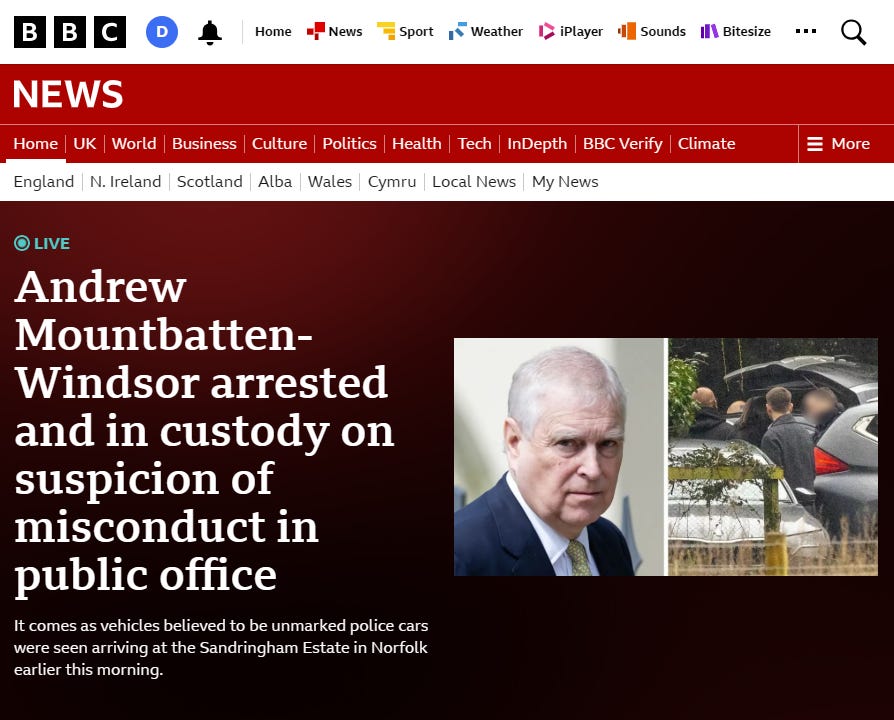
Police in the UK have arrested Andrew Mountbatten-Windsor on suspicion of misconduct in public office, according to multiple mainstream news organisations reporting police confirmation of the arrest of “a man in his 60s” in Norfolk. The reporting places the arrest at Wood Farm on the Sandringham estate, with searches also being carried out at addresses in Norfolk and Berkshire.
That combination of details — age, location, and the intense media focus — leaves little doubt about the identity of the suspect, even if the police statement itself is framed cautiously. Reuters, for example, reports the arrest directly in connection with Andrew Mountbatten-Windsor and says it relates to allegations involving the late Jeffrey Epstein.
What is he suspected of?
The suspicion being reported is misconduct in public office, a serious common-law offence that applies when someone who holds public office is alleged to have abused the trust of that position. In plain terms, it is about the alleged misuse of an official role, rather than (say) a private moral failing.
The core allegation described in the reporting is that, during a period when Andrew held an official public role connected to UK trade work, he shared confidential or sensitive information with Epstein — a convicted sex offender who moved in elite circles and cultivated access to influential people. Reuters says the focus is on alleged sharing of confidential government information with Epstein, with reference to materials said to be from 2010 and linked to trade-related trips.
AP similarly reports that police action followed an assessment of allegations that trade reports were sent to Epstein.
The Guardian’s live coverage adds colour about the nature of the material described, reporting that emails released in US document dumps are said to show briefings or reports being forwarded.
At this stage, what matters is what the offence requires and what police must establish: not merely that there was a relationship or social contact, but that there was a serious breach of duty connected to a public office, and that it reached the threshold of criminality.
Why now? The trigger appears to be new material from the United States
A striking aspect of today’s events is the timing: the reporting repeatedly points to newly released US documents connected to Epstein as the catalyst that brought the matter back to a point of active criminal investigation. Reuters describes the allegations as surfacing following the release of a very large set of US government documents related to Epstein, which prompted scrutiny and, ultimately, the UK police action now under way.
That “why now” is important because it suggests this is not simply a re-litigation of public scandal, but an investigation that police believe is justified by fresh evidential leads (or at least fresh visibility of alleged communications), sufficient to move from assessment into an active investigation and an arrest.
What does an arrest mean in UK terms?
An arrest is not a conviction, and it is not even a charging decision. It is, however, a major step. In UK criminal procedure, arrest typically indicates police believe it is necessary and proportionate to detain and interview a suspect under caution, and potentially to secure evidence (including through searches).
The reports that searches are being conducted at multiple locations matter because they strongly imply the investigation is not just about taking a statement: it is about gathering material — documents, digital devices, correspondence, or other records — that could corroborate or contradict what has been alleged.
From a reader’s perspective, this is the key point: the existence of an arrest tells us the investigation has entered a formal, high-stakes phase, but it does not tell us what the evidence will ultimately show.
The Epstein connection — and the sensitivity around “official” access
Public interest in Epstein’s networks has always been fuelled by two overlapping concerns:
Sexual exploitation and trafficking (a moral and criminal horror in its own right), and
The possibility that access to power created opportunities for influence, leverage, or compromise.
Today’s reported allegation sits squarely in the second category: that Epstein may have been given access to information he should never have had — not because of his official status (he had none), but because he cultivated relationships with people who did.
The Guardian’s reporting indicates that the police focus is on alleged sharing of sensitive information during Andrew’s trade role, and Reuters describes the allegation as involving confidential government information.
Even if the information in question were not “national security” material in the strict sense, the principle is the same: public office is held on trust. The alleged misuse of that trust is what makes this legally distinct from yet another round of reputational fallout.
For the Royal Family as an institution, the stakes are painfully obvious. A police arrest involving the King’s brother is constitutionally and reputationally serious — yet the constitutional position is also clear: policing and prosecution decisions are not supposed to bend around royal sensitivities. Reuters’ report notes the public significance and the nature of the alleged offence, and today’s coverage across outlets underscores the pressure on institutions to demonstrate equal application of the law.
What happens next?
There are several plausible near-term steps, and they may happen quickly:
Interview under caution (already implied by “in custody” reporting).
Further searches and digital forensics on any seized devices or records (a process that can take time, but the decision to search tends to happen early).
A decision to release without charge, release under investigation, or seek charge — depending on the evidence and the relevant tests for prosecution.
It is also possible (and worth stating plainly) that the investigation could broaden beyond the initial allegation if evidence points that way — or narrow if the evidence does not substantiate the claim to the criminal standard.
Why this story is bigger than one individual
This isn’t simply “royal scandal” in the tabloid sense. The reason it has become a major breaking-news event is that it touches three of the UK’s most sensitive fault-lines at once:
Public trust in institutions — whether rules apply evenly.
The boundary between private relationships and public duty — especially when elite networks overlap with official roles.
The long shadow of the Epstein case — which continues to generate new allegations and new documentary trails years after his death.
At the centre of it all is a very specific legal question: did a public role — and the access and credibility that came with it — become a conduit for improper disclosure or influence? That is what investigators will now be trying to answer, and it is why today’s development is being treated with such seriousness.
For now, the only responsible stance is to hold two truths at the same time: the arrest signals that police believe there is a case serious enough to justify detention and searches, and the suspect remains entitled to due process and the presumption of innocence unless and until charged and convicted.