

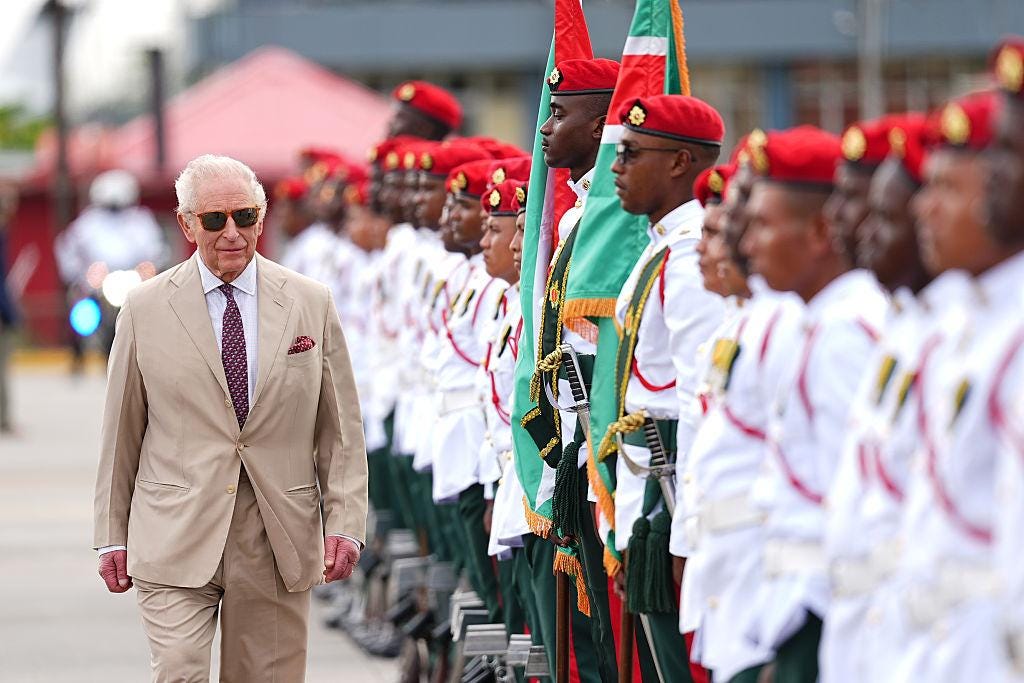
One man, fifteen crowns. King Charles has just visited three Caribbean countries, but only two still recognise him as their monarch. If a country decides it no longer wants a king, how does it actually get rid of him?
Between 27 October and 4 November 2026, King Charles III visited the Caribbean.
His itinerary included The Bahamas, Guyana, and Antigua and Barbuda. But there was an interesting constitutional distinction between those visits.
In The Bahamas and Antigua and Barbuda, Charles was visiting countries of which he is King. In Guyana, he was visiting a republic.
Buckingham Palace even used different terminology. In The Bahamas and Antigua and Barbuda, Charles was making a royal visit. In Guyana, he was making a state visit.
The distinction is subtle but constitutionally significant. You don’t make a state visit to a country of which you’re already the head of state.
All three countries are independent members of the Commonwealth. All three have historical connections to the British monarchy. But only two still have Charles as their head of state.
And that raises an interesting question.
If a country decides it no longer wants a king, how exactly does it get rid of him?
The answer turns out to be rather more complicated than simply sending Buckingham Palace a polite letter.
Fifteen crowns, one head
As we discussed in The World’s Monarchies: Part One, Charles III is King of fifteen independent countries.
This is an important distinction. Charles isn’t King of Canada or Jamaica because those countries are somehow subordinate to Britain. He holds fifteen separate constitutional positions, even though they all happen to be occupied by the same person.
The Canadian Crown is legally distinct from the British Crown. So is the Jamaican Crown. And so on.
Consequently, Britain cannot decide to abolish the monarchy in Jamaica. Nor could Jamaica decide that Canada should become a republic.
Each country has its own constitution, its own laws and its own procedures for changing them.
And those procedures vary enormously.
Barbados: the relatively straightforward approach
On 30 November 2021, Barbados celebrated the 55th anniversary of its independence by becoming a republic.
At midnight, Queen Elizabeth II ceased to be Queen of Barbados, and Dame Sandra Mason became the country’s first President.
Mason had previously been Governor-General, representing the Queen. The change therefore had a pleasing symmetry: the person who had been carrying out the monarch’s constitutional duties became the person holding the new office of head of state.
The important thing is how Barbados achieved this.
Its Parliament passed a constitutional amendment by the required two-thirds majority. The legislation replaced the monarch and Governor-General with a President elected by Parliament.
There was no referendum.
No constitutional convention lasting years.
And certainly no need to ask Elizabeth II for her personal political approval to abolish her own position.
There is a small constitutional subtlety here. The legislation still had to pass through the usual formal processes, including royal assent, exercised by the Governor-General.
In other words, the Crown participated in the formal enactment of legislation that abolished the Crown.
Constitutional monarchies can be rather good at producing these little paradoxes.
The country remained a member of the Commonwealth, maintained its diplomatic relationship with Britain, and continued with its existing parliamentary system of government.
The Queen had been replaced by a President. The government continued to function much as before.
Of course, constitutional changes of this kind are never entirely trivial. Laws, official appointments, oaths and other references to the Crown all need to be considered.
But Barbados demonstrated that a country could remove its monarch without overturning its entire system of government.
Jamaica: the more complicated approach
Jamaica has been independent since 1962.
And for much of that time, there have been politicians arguing that an independent Jamaica should have a Jamaican head of state.
The argument is not particularly difficult to understand. Why should the head of state of a Caribbean country be someone who lives in Britain and inherited the position from his mother?
But agreeing with that argument and actually changing the constitution are two different things.
Jamaica’s constitution protects certain provisions against easy amendment. Replacing the monarchy requires more than an ordinary parliamentary majority. The relevant constitutional changes require substantial parliamentary support and approval in a referendum.
And this isn’t merely a theoretical discussion.
In November 2024, the Jamaican government introduced the Constitution (Amendment) (Republic) Bill, part of a wider programme of constitutional reform. The first phase of that programme is intended to replace the monarchy with a Jamaican head of state.
The bill has been considered by a parliamentary joint select committee, but the country has not yet completed the legislative and referendum process required to become a republic.
That means republican campaigners have several hurdles to overcome.
First, they need sufficient agreement among politicians to pass the legislation.
Then they need to persuade the electorate to support the proposed changes.
And before either of those things can happen, they need to agree on what should replace the monarchy.
Should the President be elected directly by voters? Chosen by Parliament? Appointed through some other process?
What powers should the President have?
Should the new office simply inherit the largely ceremonial functions currently performed by the Governor-General?
These are not necessarily questions on which all republicans agree.
Which brings us to a particularly instructive example.
Australia: when republicans defeat republicanism
In 1999, Australia held a referendum on becoming a republic.
The proposal would have replaced the Queen and Governor-General with a President appointed by a two-thirds majority of the federal Parliament.
It failed.
Only about 45% of voters supported the change, and not a single state voted in favour.
But the interesting thing is that not everyone who voted against the proposal was a monarchist.
Some republicans wanted a President elected directly by the people, rather than one selected by politicians.
They therefore opposed the particular republican model being offered.
The result was that monarchists and some republicans found themselves on the same side of the referendum.
Australia also has a particularly demanding constitutional amendment procedure.
A proposed change generally needs a national majority of voters and majorities in at least four of the six states.
This is known as the double majority.
It’s a high hurdle, deliberately designed to prevent fundamental constitutional changes being made without broad national and regional support.
Australia’s experience illustrates an awkward problem for republican movements.
It’s possible for people to agree that they don’t want a monarchy, but disagree so strongly about what should replace it that the monarchy survives.
The status quo has one considerable advantage over any proposed alternative.
Everyone already knows how it works.
Canada: the constitutional nightmare
And then there’s Canada.
Canada might be the most difficult Commonwealth realm in which to abolish the monarchy.
Under its constitutional amendment rules, a change to the office of the King requires the agreement of the federal Parliament and all ten provincial legislatures.
Not a majority of the provinces.
Not seven out of ten.
All ten.
That is an extraordinary requirement in a country where federal and provincial governments regularly disagree about matters considerably less fundamental than the identity of the head of state.
And the problem is not merely procedural.
The Crown is deeply embedded in Canada’s constitutional structure. The monarch is part of the federal Parliament, and the provinces have their own relationships with the Crown through their lieutenant governors.
Replacing the monarchy would therefore raise questions about institutions throughout the Canadian federation.
There are legal debates about precisely how extensive the necessary constitutional changes would be. But the central difficulty is clear enough.
Even if a substantial majority of Canadians decided tomorrow that they would prefer a republic, translating that preference into constitutional reality would be a formidable undertaking.
Canada demonstrates that a monarchy doesn’t necessarily need enthusiastic popular support to survive.
Sometimes it just needs a constitution that makes replacing it extraordinarily difficult.
Does the King get a vote?
Here’s another interesting question.
Suppose Jamaica, Australia or Canada successfully completes all the constitutional procedures necessary to become a republic.
Can Charles III refuse?
Not in the sense of exercising a personal political veto over a country’s democratic decision.
In a constitutional monarchy, the sovereign acts within the country’s constitutional arrangements and, in normal circumstances, on the advice of the appropriate ministers.
There may be formal steps involving royal assent or the Governor-General, depending on the constitution concerned. Indeed, as we saw in Barbados, the Crown may have to participate in the legal process that brings its own existence to an end.
But that doesn’t mean Charles gets to decide whether he personally approves of the change.
The modern British monarchy has long accepted that the independent Commonwealth realms must decide their own constitutional futures.
Which is just as well.
A king attempting to prevent an independent country from removing him would be making an unusually persuasive argument for republicanism.
What about the Commonwealth?
There’s one final misconception worth clearing up.
Becoming a republic does not mean leaving the Commonwealth.
The Commonwealth is a voluntary association of independent countries, most of which are already republics.
India became a republic in 1950 while remaining a member. Ghana followed in 1960. Guyana became a republic in 1970. Barbados joined them in 2021.
Charles III is Head of the Commonwealth, but that is a separate role from his position as monarch of the fifteen Commonwealth realms.
The Head of the Commonwealth is not the sovereign of every Commonwealth member.
Indeed, the position is not automatically hereditary in the way the British Crown is.
A country can therefore abolish its monarchy, remain in the Commonwealth and continue to recognise Charles as Head of the Commonwealth.
There is no contradiction.
And what happens to the line of succession?
This is, after all, a blog about the line of succession. So we should probably address what happens to it when a country becomes a republic.
The answer is surprisingly simple.
Nothing.
At least, nothing happens to the British line of succession.
When Barbados became a republic in 2021, it didn’t change anyone’s position in the British succession. It simply stopped having a monarch.
Prince Charles remained heir apparent to the British throne. Prince William remained second in line. And when Elizabeth II died the following year, Charles became King of the United Kingdom and the other fourteen realms, but not Barbados.
There’s an interesting contrast here with the Succession to the Crown Act 2013.
That legislation changed the rules of succession, ending the preference for younger sons over older daughters for people born after 28 October 2011.
Because the Commonwealth realms share the same monarch, the changes required coordination between their governments. The intention was to ensure that the same person would continue to inherit each Crown.
Otherwise, different succession rules could theoretically produce different monarchs in different realms.
But becoming a republic is different.
A country isn’t choosing a different person to inherit its Crown. It’s abolishing that Crown altogether.
So Prince William would remain heir apparent to the British throne, regardless of how many other countries chose to become republics.
The succession continues. There are simply fewer thrones to inherit.
So who’s next?
Jamaica remains an obvious candidate to become the next Commonwealth realm to replace its monarchy.
Other Caribbean countries have also discussed republicanism, and Barbados has provided a recent example of how the transition can be managed.
But predicting the next republic is considerably easier than predicting when it will actually happen.
Constitutional reform is often slow. Governments have other priorities. Political parties disagree. Voters may support republicanism in principle without considering it particularly urgent.
And, as Australia demonstrated, agreeing that the present arrangement should change is not the same as agreeing on its replacement.
Charles III may eventually cease to be King of one or more of his current realms.
His successors may inherit fewer crowns than he did.
But none of those changes would necessarily affect the British line of succession.
And that’s perhaps the most interesting feature of the modern Commonwealth monarchy.
One person can wear fifteen crowns.
But each country gets to decide whether it wants to keep its own.
And removing one of those crowns doesn’t disturb the others.